


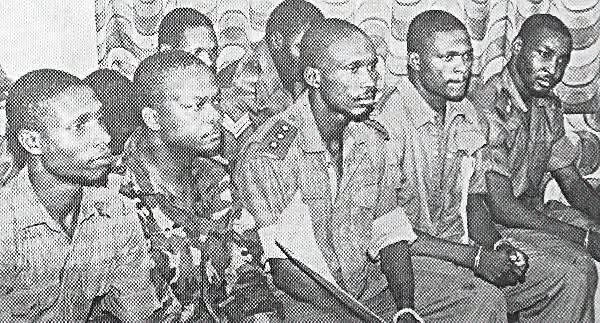
Since gaining independence in 1960, Nigeria’s political history has been shaped not only by successful military takeovers, but also by failed and foiled coups that never achieved their aim.
These aborted plots, from 1966 to 2025, have left deep scars, shaped public trust, and tested the country’s long journey toward stable democracy.
The January 15, 1966 Coup — Nzeogwu and the Young Majors
The first major intervention came on January 15, 1966, when Major Chukwuma Kaduna Nzeogwu led a group of young officers against the civilian government of Prime Minister Abubakar Tafawa Balewa.
The plotters accused the government of corruption and mismanagement. They assassinated key political leaders, including Balewa and Northern Premier Ahmadu Bello, but failed to seize full control of the country.
Major-General Johnson Aguiyi-Ironsi eventually took power, making the coup partially successful in toppling the government, but a failure in achieving its original objectives.
The February 13, 1976 Dimka Coup
A decade later, on February 13, 1976, Lieutenant Colonel Bukar Dimka led an attempt to overthrow the government of General Murtala Mohammed.
The coup began with the assassination of Murtala in Lagos, but loyal troops quickly restored order under General Olusegun Obasanjo.
Dimka and several of his collaborators were captured and executed. The incident shocked the nation and led to tighter discipline within the military.
The April 22, 1990 Orkar Coup
On April 22, 1990, Major Gideon Orkar and a group of middle-ranking officers launched one of the boldest coups in Nigeria’s history against General Ibrahim Babangida.
The plotters seized parts of Lagos, took over a radio station, and announced a new government that controversially proposed excising some northern states from Nigeria.
Babangida narrowly escaped, regrouped loyal troops, and crushed the rebellion. Orkar and his fellow plotters were later executed.
The December 1997 Alleged Diya Plot
In December 1997, the government of General Sani Abacha announced it had foiled a coup plot allegedly led by his deputy, Lt. General Oladipo Diya, alongside General Abdulkareem Adisa and others.
Diya and his co-accused were arrested, tried in a televised tribunal, and sentenced to death. They were later pardoned following Abacha’s sudden death in 1998.
To this day, Nigerians still debate whether it was a genuine plot or a setup to purge Abacha’s inner circle.
The Alleged 2004 Plot Against Obasanjo
During President Olusegun Obasanjo’s civilian administration, reports emerged in 2004 of a plot by some retired and serving officers allegedly linked to the late Abacha regime to remove him from office.
The government said the plot was foiled before it matured, but full details were never made public. The episode highlighted the lingering influence of military politics in the post-military era.
Rumours Under Buhari, 2015 – 2023
Under President Muhammadu Buhari, security agencies occasionally warned of plots by disgruntled soldiers, but none were ever proven or publicly linked to a real operation.
The alerts nevertheless revealed continuing tension between civilian authority and sections of the military.
The Alleged October 2025 Plot Against Tinubu
The most recent and controversial episode came in October 2025, when reports claimed several senior military officers had been arrested for allegedly planning a coup against President Bola Ahmed Tinubu.
Local media reports suggested the plan was to strike on Independence Day, October 1. The Defence Headquarters denied any coup plot, insisting the detained officers were being investigated for professional misconduct, not treason.
However, the subsequent replacement of top security chiefs and tight control of military information fuelled speculation that something significant had occurred behind the scenes. Whether a real coup was foiled or the rumours were exaggerated remains uncertain.
Conclusion
From 1966 to the alleged plot of 2025, Nigeria’s story shows how the shadow of military intervention has never fully disappeared from national life.
Each failed attempt has left lessons about ambition, power, and the fragility of governance. Yet despite these challenges, Nigeria’s democracy continues to endure, reflecting a growing commitment to civilian rule and constitutional order.