


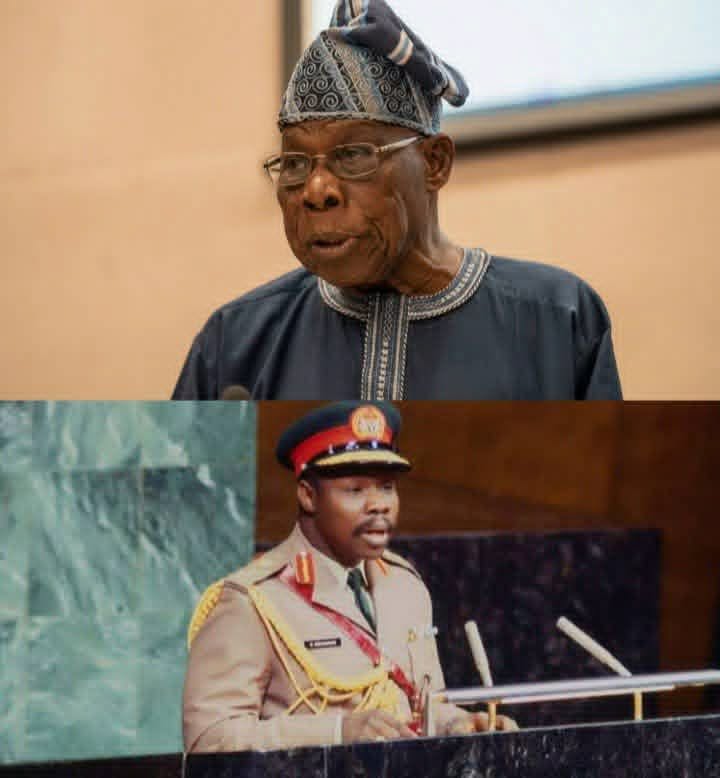
Former President Olusegun Obasanjo has revealed that the late military dictator, General Sani Abacha, targeted him for “liquidation” because Abacha felt unsafe with him remaining free.
Obasanjo made the revelation while recounting his arrest and imprisonment under the Abacha regime.
According to him, when he left office as Head of State in 1979, he was only 42 years old. Having attained the rank of a four-star General and reached the highest political office in the country, he felt his career had peaked too early.
“I left government too early,” Obasanjo said. “So I decided to go into farming until I was arrested.”
He explained that while travelling abroad, the United States Ambassador to Nigeria contacted him to warn that he would be arrested on his return to the country. The US government, he said, offered him political asylum.
Obasanjo said he rejected the offer, insisting he had committed no crime and would not become a fugitive.
Upon landing in Nigeria, security operatives immediately seized his passport. When he arrived at his farm, his security detail informed him that the property was surrounded.
Shortly after, a plainclothes police officer arrived with an invitation from an Assistant Inspector-General of Police (AIG).
Obasanjo said he insisted on driving himself to the police station in his own vehicle, where the AIG formally informed him that there were orders to arrest him.
He disclosed that former US President Jimmy Carter personally intervened on his behalf by appealing directly to Abacha. The diplomatic pressure, he said, temporarily saved him from a secret detention facility and led to house arrest instead.
The reprieve was short-lived. At about 1:00 a.m., while he was playing squash, security operatives arrived at his residence, took him away, and transferred him into the prison system.
Obasanjo had been an open critic of the Abacha administration. In 1995, he was arrested, secretly tried, and convicted for allegedly masterminding a phantom coup against the military government — a charge he consistently denied and described as a setup.
He remained in prison until Abacha’s sudden death in 1998.
Following his release, Obasanjo went on to contest and win the 1999 presidential election, returning as Nigeria’s civilian president.