


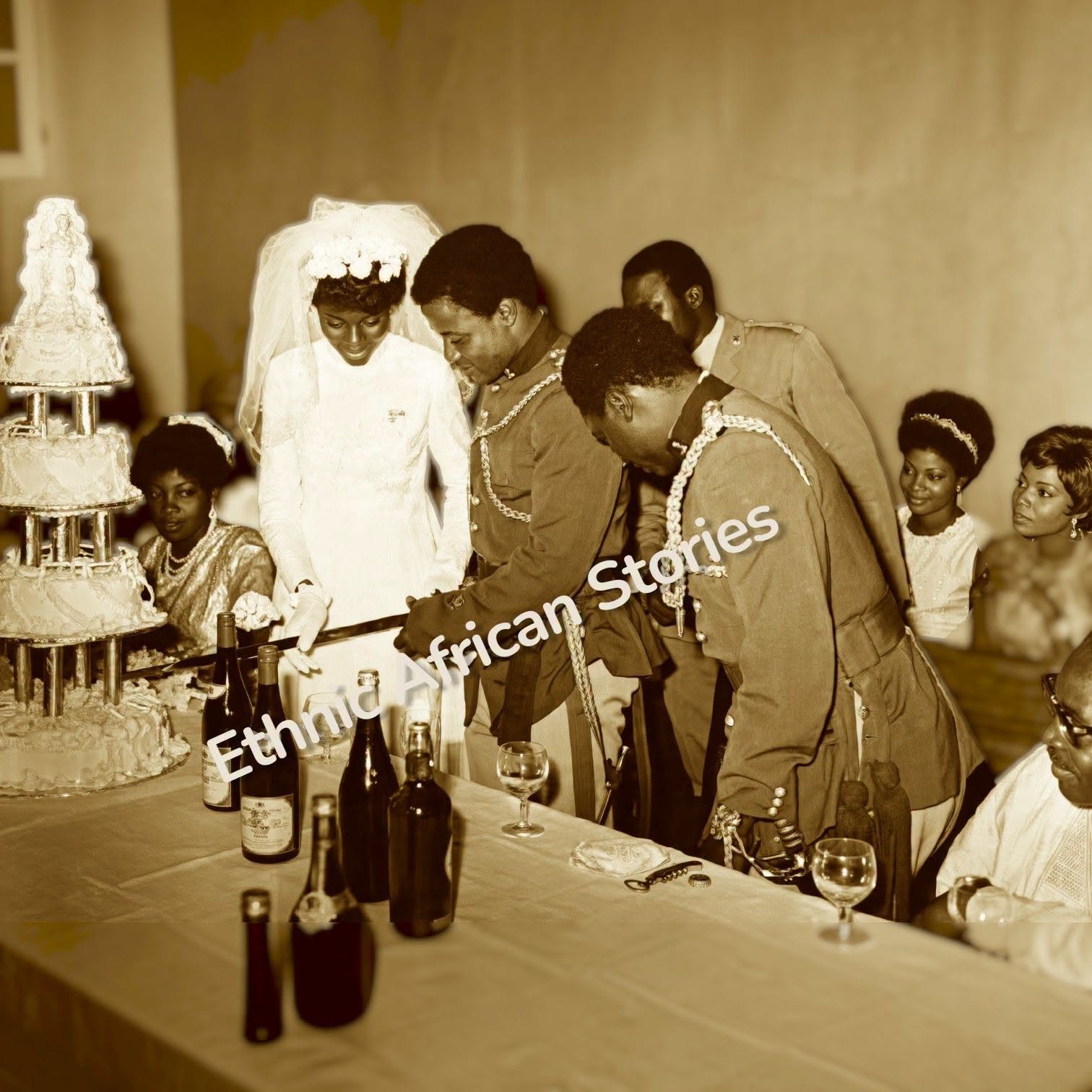
56 years after their wedding, Ibrahim Babangida’s tribute to Maryam in his autobiography reveals the man behind the uniform.
THE PHOTO
It is easy to miss if you scroll past quickly. Grainy, slightly faded, the colours washed out by time.
September 6, 1969. Kaduna Marriage Registry.
A young officer, trim moustache, side-parted hair, leaning forward with a knife. Beside him, a young woman in a white wedding dress with a soft veil, smiling shyly, her hand over his. Between them, a three-tiered wedding cake.
There is no presidential seal. No red carpet. No retinue of aides.
It is just Ibrahim and Maryam.
The photo has resurfaced this week after Babangida revisited it in his much-anticipated autobiography, _A Journey in Service_ (2025), and in one sentence, stripped away decades of myth around Nigeria’s most enigmatic former ruler.
“I never imagined that Maryam would pass away before I did, but the gift of life is in Allah’s hands, not in humanity’s.”
THE WEDDING
At the time, he was Major Ibrahim Badamasi Babangida, 28, a war-tested officer who had fought on the federal side of the Nigerian Civil War and survived a bullet that remains lodged in his chest till today.
She was Maryam King, 21, the eldest daughter of Hajiya Nneka King and Leonard Nwabueze King. Born in Asaba, raised in Kaduna, educated at Queen Amina College. Elegant, well-spoken, and known among her peers for her quiet confidence.
Their paths had crossed at social gatherings in Kaduna, then the capital of the North and the heartbeat of the Army. The courtship was brief and deliberate, as military courtships often were in those days.
The wedding was in two parts — the civil registration at the Marriage Registry in Kaduna, where the famous cake-cutting photo was taken, followed by the Islamic _Nikah_. It was small, attended by fellow officers, family and close friends. No one there could have predicted that this young couple would one day occupy Dodan Barracks and define an era.
THE PARTNERSHIP
What followed was not just a marriage, but a partnership that weathered the turbulence of Nigerian history.
From Kaduna to Lagos to Minna, through postings, coups and counter-coups, Maryam remained his anchor. When Babangida emerged as Military President on August 27, 1985, after ousting General Muhammadu Buhari, Maryam entered public life with him — but on her own terms.
She transformed the ceremonial role of First Lady into a policy platform. In 1987, she launched the Better Life Programme for Rural Women, the first large-scale national initiative targeted at rural women — farmers, traders, artisans who had never been seen from Abuja.
Through Better Life, she set up cooperatives, cottage industries, farms, and literacy centres across all states. Critics called it political; rural women called it the first time government remembered them. For that, she became both celebrated and controversial — but undeniably influential. She set the template that every First Lady after her would follow.
At home, friends described her as Babangida’s confidante and moral compass — stylish but firm, private but outspoken in private. The couple had four children: Aisha, Muhammad, Aminu, and Halima.
THE VOID
On December 27, 2009, at the UCLA Jonsson Comprehensive Cancer Center in Los Angeles, Maryam Babangida died after a long battle with ovarian cancer. She was 61.
Her burial in Minna was attended by former heads of state, presidents, and ordinary women from the villages her programme had touched. Ibrahim Babangida, the man who had ruled Nigeria for eight years and survived everything politics could throw at him, wept openly.
For 15 years since, he has lived in the Hilltop Mansion in Minna, largely out of public view, receiving visitors but rarely speaking about his personal life.
Until now.
THE REFLECTION
In _A Journey in Service_, Babangida, now 84, devotes a full chapter to Maryam — not as First Lady, but as wife, mother and partner.
“I am grateful for the life Maryam and I shared and for the fruit of our union. Coping without her has not been easy, but it has been made much less demanding by the memories of our life together and the length of her shadow.”
It is perhaps the most human line in a book filled with accounts of coups, economic reforms, and statecraft.
It explains why that 1969 photograph matters. Before the SAP, before June 12, before the title Maradona, before the uniform — there was just a Major and his bride, cutting a cake in Kaduna.
And for a man who has seen it all, that remains the moment he chooses to remember.