


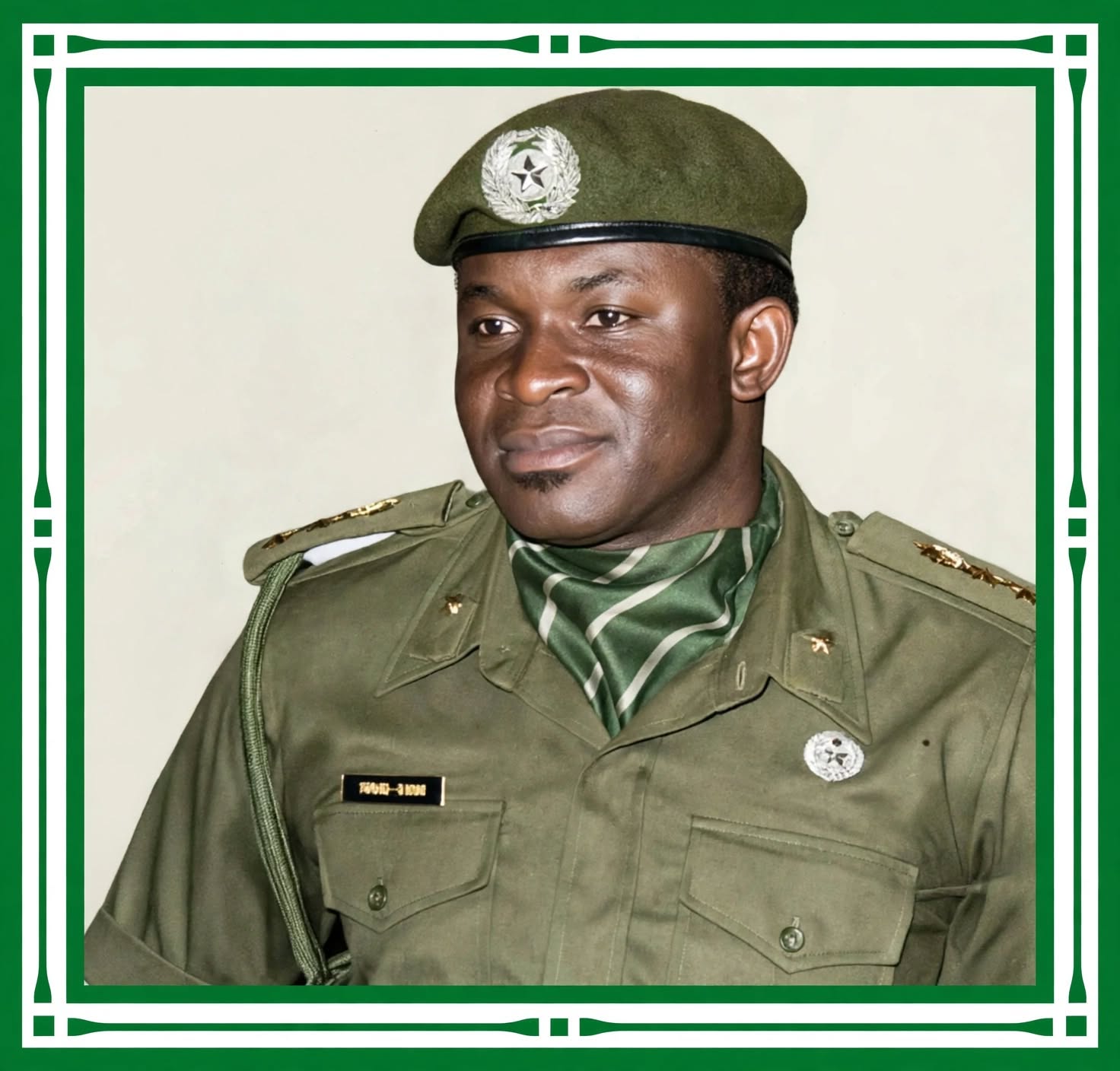
David Mark was in the Nigerian Army from 1967 to 1993 and reached the rank of Brigadier General. He then went into politics and became President of the Senate from 2007 to 2015 — the longest-serving Senate President in Nigeria’s history.
Soldier. Statesman. Leader.
Early Life And Military Training
David Mark’s military journey began at the Nigerian Military School, Zaria, where he studied from 1962 to 1966. He entered the Nigerian Defence Academy, Kaduna, in 1967 as part of the 3rd Regular Course during the civil war.
He graduated in 1970, top of his class, as a Communications Engineer and was commissioned as a Second Lieutenant into the Nigerian Army Signals Corps.
After his commission, he trained at the School of Signals, Blandford, England in 1970, and later studied at the College of Military Engineering, Poona, and the Military College of Telecommunication Engineering, Mhow, between 1971 and 1975. He also attended the Command and Staff College, Jaji, from 1978 to 1979.
Commissioned as a 2nd Lieutenant in 1970, he rose rapidly — Captain by 1971 — through the technical ranks of the Signals Corps, combining operational duties with academic and command appointments. Early in his career, he was in charge of the military communications training establishment.
Governor, Minister And ‘Babangida Boy’
Mark was not just a Signals officer. He was at the heart of Nigeria’s military power structure from 1983 to 1993.
As a Lieutenant Colonel, he was part of the core group of mid-level officers who carried out the coup that overthrew the Shehu Shagari civilian government on December 31, 1983. That role led directly to his appointment as Military Governor of Niger State in January 1984 by Major General Muhammadu Buhari.
As Governor from 1984 to 1986, Mark was heavily involved in rural development and education. His most notable initiative was the introduction of policies which made female education compulsory in the state.
Following General Ibrahim Babangida’s overthrow of Buhari in August 1985, Mark remained in the inner circle. He became a member of the Armed Forces Ruling Council (AFRC), the apex decision-making body in the country, and was widely regarded as one of its youngest and most influential members.
He served as Minister of Communications under Babangida from 1987 to 1993. During that period, he was in charge of NITEL and NIPOST, restructured NIPOST, introduced city postal codes, oversaw the construction of digital earth stations in Lagos and Enugu, and set up Nigeria’s first mobile phone networks.
His administration was also characterised by a tough disciplinary regime on parastatal staff and a hard line on cable vandalism. It was also a period that brought him into the spotlight for some of his controversial comments on access to telephone service.
Political historians routinely describe Mark as one of the so-called “Babangida Boys” — the trusted inner circle of the Babangida regime.
Retirement, Exile And Return
Mark’s military career ended abruptly during the political turmoil following the annulment of the June 12, 1993 presidential election.
Immediately after General Sani Abacha removed Ernest Shonekan’s Interim National Government on November 17, 1993, Abacha moved to get rid of senior officers of the Babangida regime. Mark was compulsorily retired from the Army alongside prominent contemporaries including Brigadier General John Shagaya and Lt. General Joshua Dogonyaro.
In April 1994, from London, Mark broke military silence in a landmark interview with _Newswatch_ magazine titled “Abacha Coup: Our Original Plan.”
In the interview, he accused Abacha of engineering the annulment of the June 12 election to avoid Babangida’s fate, and described Abacha’s regime as “the greatest betrayal of the century” for planning to remain in power for at least five years rather than restore democracy. He also alleged that some pro-democracy politicians and associates of MKO Abiola had secretly persuaded Abacha to take power.
The interview triggered a massive security crackdown. Abacha’s State Security Service (SSS) declared _Newswatch_ directors Ray Ekpu, Dan Agbese and Yakubu Mohammed wanted, arresting and detaining them in solitary confinement on sedition charges. Mark himself became a person of interest to Abacha’s intelligence service and was forced to remain in self-imposed exile in England until Abacha’s sudden death in June 1998.
From Soldier To Statesman
Mark returned to Nigeria after Abacha’s death and entered democratic politics in 1999.
He went on to become Nigeria’s longest-serving Senate President, presiding over the Senate from 2007 to 2015, a period that included ensuring the democratic transition in 2010 during the Yar’Adua illness crisis.
Opinions on his transition from soldier to statesman remain split. Some see his military background as the bedrock of the discipline and leadership he brought to the Senate, while others remain critical of his past policies and his role during the military era.
David Mark’s public life spans five decades. He was one of the architects of the military regimes of the 1980s, went into exile in the 1990s, helped stabilise democracy in the 2010s, and remains active in his late 70s.
His story, in many ways, encapsulates Nigeria’s journey from military rule to constitutional democracy.