


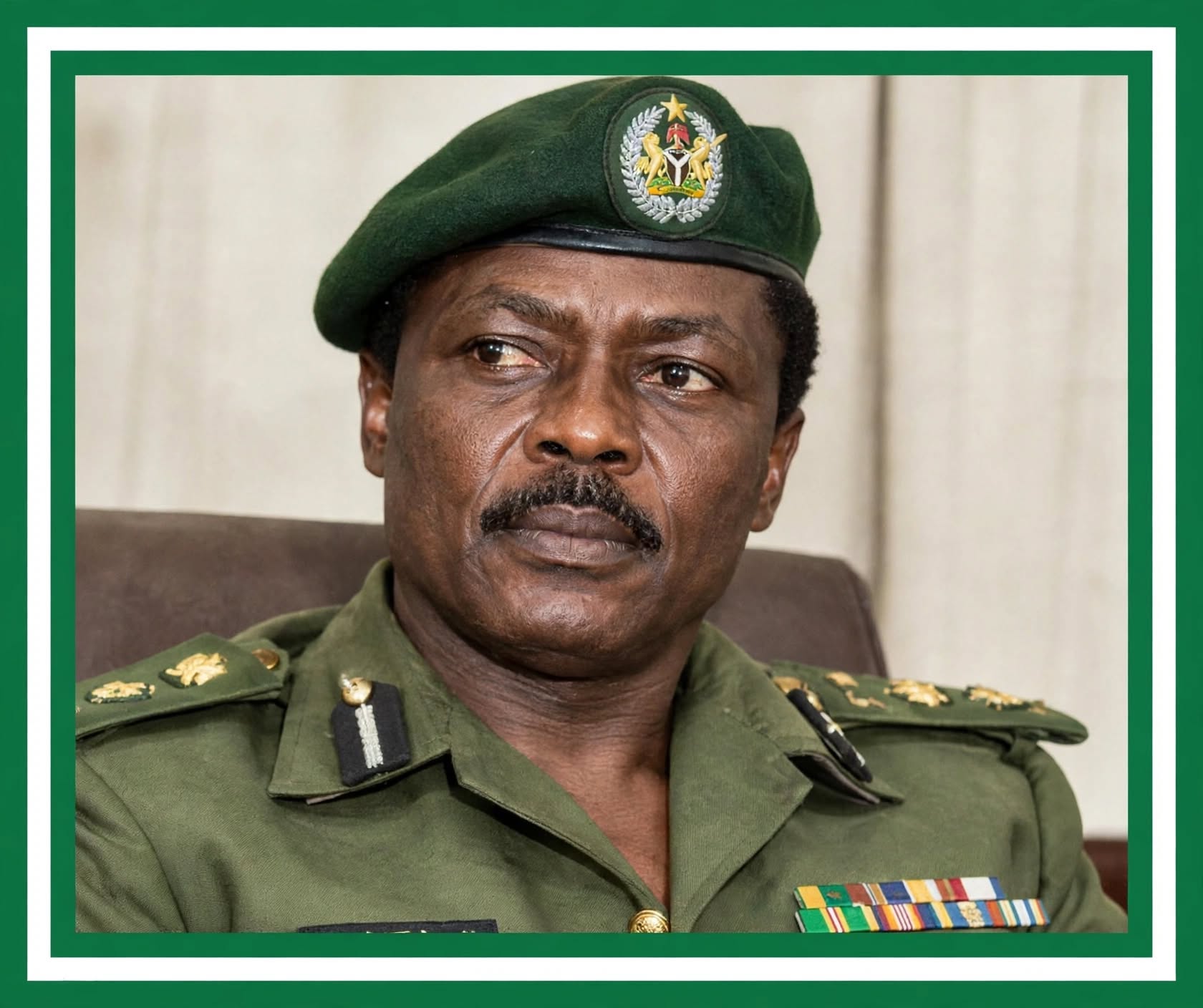
On April 22, 1990, Nigeria woke up to gunfire at Dodan Barracks and a broadcast that shook the nation. Major Gideon Orkar announced on radio that the government of General Ibrahim Babangida had been overthrown.
Behind that broadcast was a quieter, more ideological figure — Colonel Anthony “Tony” Otu-Nyiam (Rtd.)
Soldier. Strategist. Survivor. Author.
Thirty-five years on, Nyiam is still alive to tell the tale, and he still has no regrets.
Who Is Tony Nyiam?
Colonel Anthony Otu-Nyiam is a retired Nigerian Army officer, author and national security commentator from Boki in Cross River State.
He served in the Nigerian Army Corps of Engineers and holds a BSc in Quantity Surveying and an MSc in International Relations from the University of Aberdeen, Scotland. He was also on temporary secondment to the British Army.
Nyiam attended the Nigerian Military School, Zaria, and later joined the 9th Regular Combatant Course at the Nigerian Defence Academy, Kaduna, in 1971.
After his commission into the Corps of Engineers, he served at Army Headquarters under General Ibrahim Babangida and as Directing Staff at the Command and Staff College, Jaji.
The Ideological Brain Of The 1990 Uprising
Alongside Majors Saliba Mukoro and Cyril Obahor, Nyiam is described by historians as the ideological brain of the April 22, 1990 uprising. Major Gideon Orkar was the face who made the public broadcast.
Nyiam says the coup was not motivated by ambition, but by frustration — frustration over restructuring, corruption, and the future of Nigeria.
The plotters wanted to see the South and the Niger Delta properly represented and not sidelined in the Nigerian federation.
But the rebellion collapsed, in part, because of Orkar’s broadcast itself. Orkar’s call to excise the five far-northern states alienated northern officers and gave loyalists under Lt. Gen. Sani Abacha a rallying point to mobilise.
How The Coup Was Moved Forward By Six Days
According to the historical record, including Babangida’s own memoir _A Journey in Service_, the coup was initially scheduled for April 28, 1990.
On April 21, Nyiam met with the then Lagos State Military Administrator, Brigadier Raji Rasaki, to check his neutrality. Suspecting Rasaki would not be neutral, Nyiam ordered men to tail him.
When Rasaki drove straight to Dodan Barracks, Nyiam immediately told Major Orkar to move the operation forward by six days — to ensure it was not pre-empted, as the Mamman Vatsa coup had been in 1986.
On the night, Orkar was in charge of the assault on Dodan Barracks, while Nyiam, with Major Saliba Mukoro and Captain Perebo Empere, took the FRCN in Ikoyi, taking an armoured vehicle as they went.
The Controversy Over Lt. Col. U.K. Bello’s Death
There remains controversy over the killing of Babangida’s Aide-de-Camp, Lt. Col. U.K. Bello, during the fighting at Dodan Barracks.
Babangida’s former Chief Security Officer, Major Abubakar Mohammed, has claimed that Nyiam shot Lt. Col. Bello in cold blood.
In a detailed response to historian Max Siollun, Nyiam has categorically denied the allegation. He said Bello had feigned surrender in order to join the plotters and then opened fire, and was subsequently killed in the crossfire.
Why The Coup Failed
Historians point to three main reasons the mutiny fell apart:
1. Babangida escaped from Dodan Barracks via a back exit.
2. The plotters were almost entirely reliant on newly recruited, green troops.
3. Orkar’s pre-recorded announcement about excising the northern states pushed northern officers, notably Lt. Col. Ishaya Bamaiyi and Lt. Gen. Sani Abacha, to bring armoured units from Ikeja Cantonment to crush the mutiny.
Escape, Exile And Survival
Of the 42 conspirators who were captured, tried by a Special Military Tribunal and shot by firing squad on July 27, 1990, Nyiam managed to escape the net.
He later revealed that he slipped out of Lagos and crossed Nigeria’s western land borders via what became known as the “NADECO route”, eventually making it to the UK.
In the UK, he was granted political asylum, which he has credited in various interviews to the intervention of the administration of former UK Prime Minister Margaret Thatcher.
During his ten-year exile, he became a key conduit between radical military elements and the civilian pro-democracy movement. He worked closely with Chief M.K.O. Abiola, Bola Tinubu, Wole Soyinka, Anthony Enahoro and Kayode Fayemi in efforts to apply international pressure on the Babangida and Abacha regimes.
He also drew on the ideology of Nigerian federalism from former Biafran leader Odumegwu Ojukwu and worked with Ken Saro-Wiwa of the Niger Delta.
He returned to Nigeria after the transition to civilian rule in 2000.
A Life Of Protest, Even Inside The Army
Nyiam grew up in the military system, but he deliberately refused to speak Hausa — even though he understood it — as a form of protest against what he saw as cultural assimilation of the troops. He believed the Army was meant to be a Nigerian Army, not a regional army.
Prior to 1990, Nyiam was operating in the inner circles of Army Headquarters. Given their proximity to General Babangida and their aggressive stance, Nyiam and his immediate peers were informally known as the “Junior AFRC.”
He used his official role of helping to put together Babangida’s proposed National Guard as a means of quietly building up logistics for a coup without attracting suspicion.
Clash With Oshiomhole And The National Conference
In 2013, President Goodluck Jonathan appointed Nyiam to the Presidential Advisory Committee on the National Conference.
Nyiam found himself in hot water at a public hearing in Benin City after he went off script and loudly disrupted Governor Adams Oshiomhole of Edo State as he expressed scepticism about the dialogue.
Under pressure from the committee leadership, Nyiam chose to step down to avoid being a distraction.
Still Fighting For Restructuring
Nyiam is a persistent critic of the 1999 Constitution, which he says has no popular legitimacy. He pushes for fiscal federalism and devolution of power.
In his media appearances, he has consistently advocated for replacing the centralised colonial security apparatus with state police and regional forces to deal with insurgency and banditry.
On the 35th anniversary of the 1990 coup in April 2025, he told the _Nigerian Tribune_ that Nigeria is still in the “master-servant” relationship imposed by the colonial elite and that the country is still trapped in it.
In recent public lectures, including an address at the Pan-National Summit in May 2025 covered by _Punch_, he warned that if non-state armed groups and militias continue to operate in parallel with severely weakened state institutions, Nigeria is on a trajectory very much like Sudan under Omar al-Bashir.
Through 2025 and 2026, he has remained a consistent advocate for dismantling the centralised police force, which he describes as a colonial “army of occupation” disconnected from the communities it is supposed to serve. He favours constitutional state policing and armed regional security forces.
Patriot, Rebel, Or Both?
Nyiam has always seen Nigeria’s political instability as more than just a failure of leadership. To him, it is a structural failure — a failure that goes back to the very act of colonial amalgamation.
History may well judge him otherwise, but you cannot tell the story of Nigeria without him.
35 years on, he says the grievances of 1990 are still with us today.