


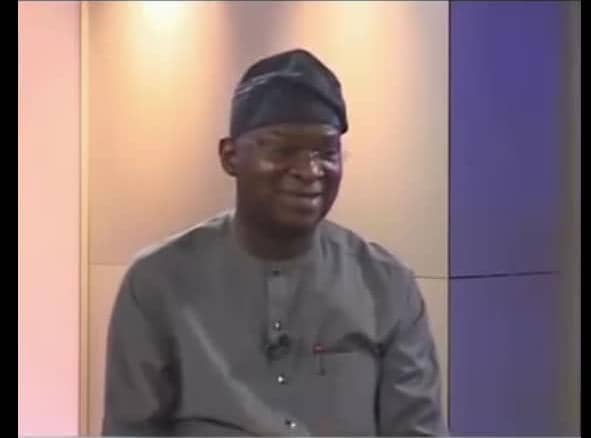
Former Governor of Lagos State and former Minister of Works and Housing, Mr. Babatunde Fashola, SAN, has said the debate over Nigeria’s national anthem is not about governance priority, but about patriotism, duty and leadership.
Fashola spoke on Channels Television’s _Politics Today_ in a one-on-one interview on true federalism, state policing, institutional reforms, and the national anthem debate.
He was asked: “Mr. Fashola, is a change in our national anthem a governance priority? And why would you begrudge anyone who doesn’t sing a certain national anthem because, through patriotism, what does it mean in a country where some citizens feel they are being let down by their government?”
In response, Fashola said the question reminded him of a recent incident where a different anthem was sung at a public event.
“Well, I hope you are not referring to the incident that happened recently about singing another national anthem,” he said.
He then anchored his argument on Section 24 of the 1999 Constitution (as amended), which he described as one of the most neglected provisions in the Constitution.
Section 24: Duties, Not Just Rights
Fashola said Nigerians are quick to assert their rights but rarely talk about their duties.
“Section 24 of our Constitution is one section I have been a champion of, because it is the section that imposes duties on us – all of us. We always assert our rights, but very few people like to talk about that section,” he said.
According to him, Section 24 mandates citizens to:
– Declare their income and pay tax
– Help law enforcement in crime fighting and provide support for them
– Respect the colours of Nigeria represented by the flag, its sovereignty, and respect the anthem and the values it espouses
“That’s the section that says you must respect the colours of Nigeria represented by the flag, its sovereignty and respect the anthem and the values it espouses,” Fashola said.
Leadership Is Not Surrender
Fashola shifted the conversation from the anthem itself to leadership, arguing that the real test of a leader is what he does when his followers are wrong.
“If a leader, the responsibility of leadership is one that puts you in a lowly and uncomfortable place, but leaders must not surrender their authority to those who follow them, especially the authority about moral rectitude,” he said.
To illustrate his point, Fashola recalled the 2008 United States presidential election, when then Democratic candidate Barack Obama publicly disowned his pastor, Reverend Jeremiah Wright, after the pastor made controversial racist remarks.
“I remember, I think it was in 2008 or thereabout, when the Democratic candidate was contesting for the presidential election in the United States and his pastor, Reverend Jeremiah Wright, said something totally racist and everything, and this candidate came out and said, ‘No, I disown that man, his views do not represent my position about this election. I am pro-everybody in this country.’ That was a leadership test and he passed.”
Fashola said a Nigerian leader faced with a similar situation should have spoken up.
“Now, if as a leader, your followers then decide that, okay, this is what they want to do, the least that you can do to pass that leadership test is to say, ‘Gentlemen, this is not right. I will not participate in this. We should not do this.’ That is where leaders earn their stripes. Not surrender their authority.”
He ended with a question he said every Nigerian should ask any leader who cannot control his supporters:
“For me, he then tells me, okay, if this leader can’t control his supporters, can he protect me from them?”