


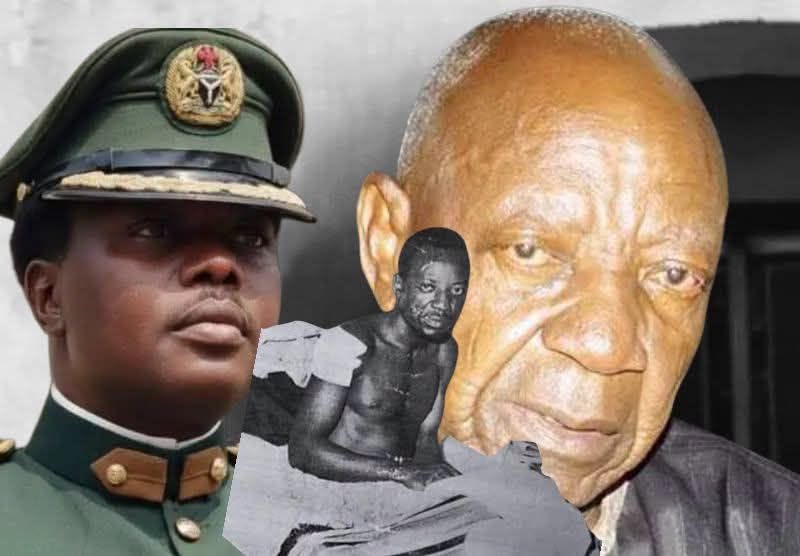
Master Warrant Officer Michael Otuwe (rtd) was the only survivor in the car on February 13, 1976. In this chilling testimony, he relives the ambush at Alagbon Junction, Ikoyi, that ended the life of General Murtala Muhammed.
It has been almost five decades, but the memory is still fresh in the mind of Master Warrant Officer Michael Otuwe (rtd).
On the morning of Friday, February 13, 1976, he was not just a soldier. He was the orderly to the Head of State, General Murtala Ramat Muhammed — the man Nigerians had come to love for his bold, reformist leadership.
By 8 a.m., that journey would end in bloodshed at a quiet junction in Ikoyi, Lagos, and Otuwe would become the sole living witness to one of the darkest days in Nigeria’s history.
In a recent interview with _Daily Trust_, the retired soldier, now an old man, narrated for the first time in detail, how the coup plotters struck.
The Final Journey
According to Otuwe, the day started like any other. The Head of State’s convoy left Dodan Barracks, the then seat of power, heading for work.
“We passed through the Federal Secretariat in Ikoyi which was undergoing renovation and covered with zinc,” Otuwe recalled.
The convoy was small, unassuming, and without the heavy security that defines presidential movement today. General Muhammed was famous for his simplicity — he often moved without sirens and with little escort.
When they got to Alagbon Junction, traffic was building up. The traffic policeman on duty did not immediately notice the flags on the Head of State’s car.
“He would have allowed the traffic in our direction to continue moving, but he stopped the five or six cars in front of us,” Otuwe said.
That brief stop would prove fatal.
The Ambush
Otuwe said he noticed some men standing by the roadside dressed in flowing agbada, also known as babariga.
“I saw some people in agbada and when they lifted them up, they brought out AK-47 rifles and fired at us.”
The men were soldiers loyal to Lt. Col. Buka Suka Dimka, the leader of the abortive coup.
In seconds, the first bullet hit the driver, Sergeant Adamu Michika, in the head.
“He fell on the arm-rest where the suitcase containing the General’s mufti was,” Otuwe said.
Instinct took over. Otuwe took cover and fell on the driver. General Muhammed and his Aide-de-Camp (ADC) also ducked for cover inside the black Mercedes Benz.
Thinking they had completed their mission, the assassins withdrew and headed towards the Nigeria Broadcasting Corporation, Radio House, to announce the takeover of government.
A Second Volley
But fate had another cruel twist.
Otuwe explained that as the ADC opened the door to help the wounded Head of State out, one of the coup plotters, a Major, turned back and saw movement.
“The Major shouted and notified his colleagues that we were alive. This made them turn and rush back and emptied their bullets in us.”
It was that second round of gunfire that killed General Murtala Muhammed and his ADC, Lt. Akintunde Akinsehinwa.
Otuwe was hit in the arm and in the hip. He slumped, lifeless, among the bodies.
“I was the only survivor,” he said quietly.
Waking Up In The Mortuary
What happened next sounds like a scene from a movie, but Otuwe insists it is true.
Troops loyal to General Muhammed arrived at the scene after the assassins had left. Seeing no sign of life, they conveyed the bodies to the mortuary.
“I recovered from coma when the breeze from the air conditioner and the pain woke me up,” he recalled.
A mortuary attendant noticed his hand move and raised an alarm. A doctor quickly confirmed he was still alive.
He was rushed first to Dodan Barracks and then to a hospital on Awolowo Road, Ikoyi, where he began the long road to recovery.
A Witness To History
General Murtala Muhammed ruled Nigeria for only 200 days — from July 29, 1975 to February 13, 1976 — but his legacy of discipline, anti-corruption and nationalism remains unmatched.
Master Warrant Officer Michael Otuwe (rtd) carries the scars of that day on his body and in his heart. His testimony remains one of the most authoritative first-hand accounts of how Nigeria lost one of its most visionary leaders.
50 years on, his voice is a reminder that history is not just written in books — it is carried by those who lived it.
This feature is based on an interview originally published by Daily Trust.