


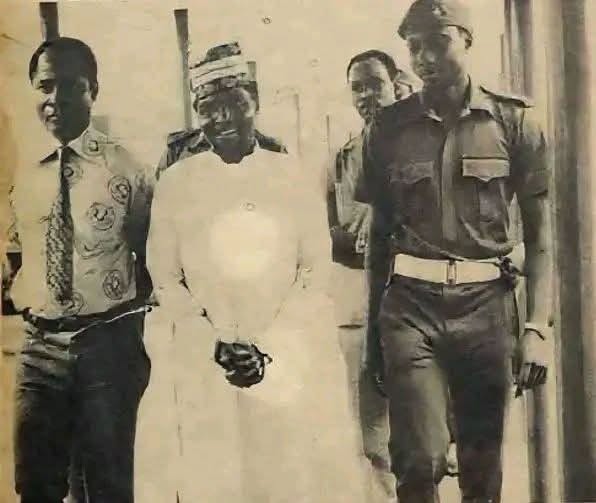
The photograph of Lieutenant Colonel Buka Suka Dimka smiling in handcuffs after his arrest remains one of the most iconic images of Nigeria’s military era. It captured the end of the failed coup of February 13, 1976, which claimed the life of Head of State, General Murtala Muhammed.
The 1976 Coup Attempt
On the morning of February 13, 1976, Dimka led a group of officers in an attempt to overthrow the Federal Military Government. His men ambushed General Muhammed’s convoy on George Street, now Murtala Muhammed Way, in Lagos. The Head of State and several members of his entourage were killed.
The plot collapsed within hours. Most military formations refused to back it. Loyal officers rallied behind Chief of Staff, Supreme Headquarters, Lt. Gen. Olusegun Obasanjo, and Chief of Army Staff, Lt. Gen. Theophilus Danjuma, to crush the rebellion.
Dimka’s Justification
In a broadcast during the coup, Dimka accused the government of corruption, indecision, weak leadership, arbitrary arrests without trial, and general maladministration. The Federal Military Government rejected the claims and described the attempt as an unlawful seizure of power.
Flight, Arrest, and the Unverified Story
After the coup failed, Dimka fled Lagos. Security forces launched a nationwide manhunt and arrested him several days later in southeastern Nigeria.
A widely repeated story claims he was arrested with a prostitute. However, this detail has never been confirmed in official government records or court-martial proceedings and remains an unconfirmed account.
Trial and Execution
Dimka was tried by a military tribunal alongside dozens of other alleged participants. Many were convicted of treason and related offences.
On May 15, 1976, Dimka and 38 other officers and civilians were executed by firing squad. It was one of the largest mass executions in Nigeria following a failed coup.
Historical Significance
The failed coup altered Nigeria’s political path. After Muhammed’s assassination, Obasanjo became Head of State. He continued the transition programme and handed power to a civilian government in 1979, ushering in the Second Republic.
The image of Dimka in handcuffs endures as a symbol of the coup’s sudden collapse and the consequences faced by its leaders.
Sources: Drum Magazine, 1976; Contemporary news reports