


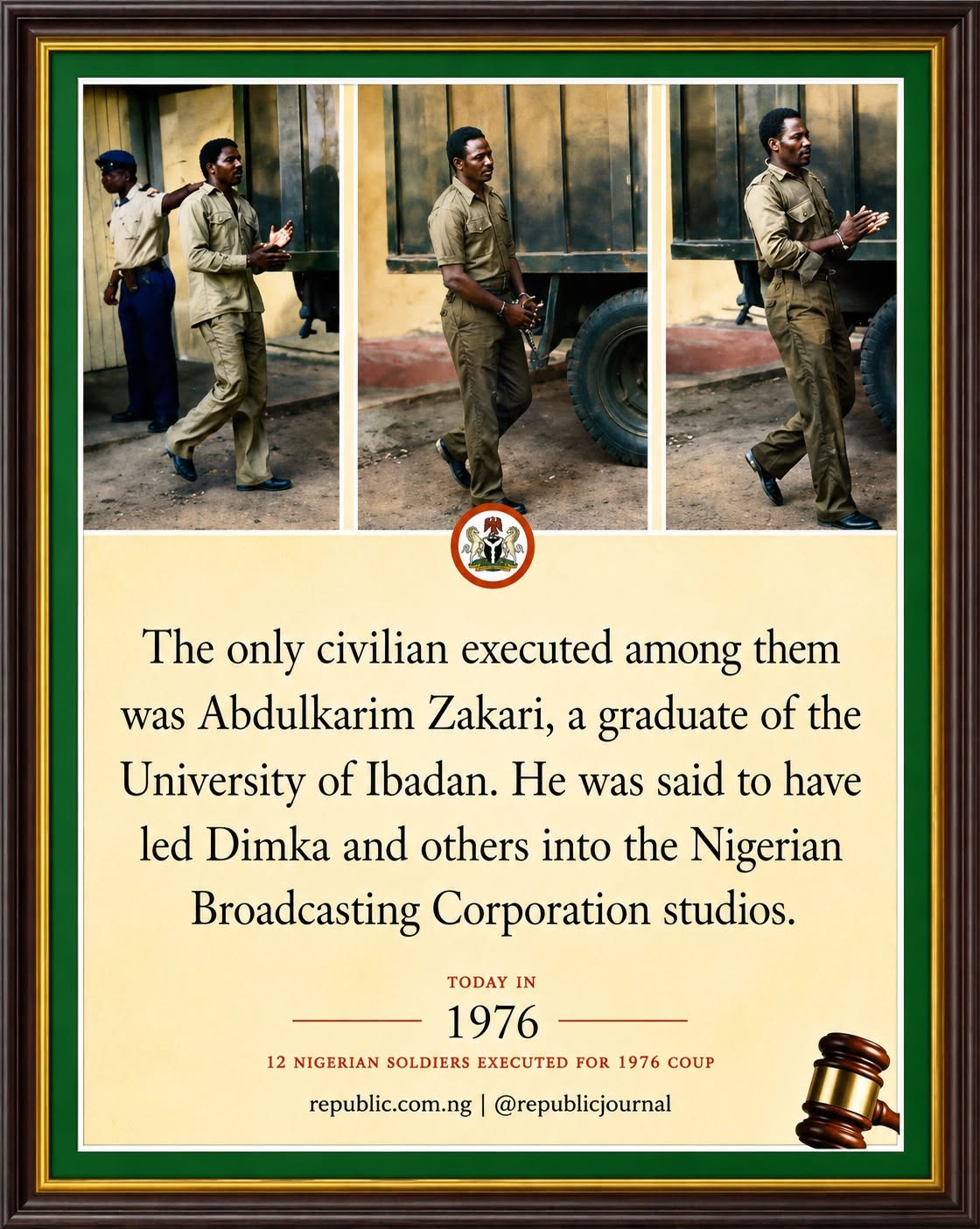
Abdulkarim Zakari was a Nigerian broadcaster and the only civilian executed for his role in the failed military coup of February 13, 1976, that led to the assassination of Head of State, General Murtala Muhammed.
A graduate of the University of Ibadan, Zakari worked as a senior radio journalist with the Nigerian Broadcasting Corporation, NBC. He was also the elder brother of Victoria Gowon, wife of former Head of State, General Yakubu Gowon, who had been ousted in a bloodless coup seven months earlier.
On the morning of the coup, plot leader Lt. Col. Bukar Suka Dimka needed urgent access to the NBC studios in Ikoyi, Lagos, to announce the overthrow of the government.
Using his credentials as a senior staff member, Zakari bypassed military security. Once inside, he:
Ushered Dimka into the live studio for the dawn broadcast
Cleared non-essential staff and set up the transmission lines
Sourced and looped martial music between announcements to signal a change of government
At about 6:30 AM, Dimka announced on air that General Murtala had been assassinated and declared a nationwide curfew.
After the coup collapsed hours later, Zakari was arrested and tried alongside senior military officers by a Special Military Tribunal chaired by Maj. Gen. John Obada.
The prosecution argued Zakari’s actions amounted to high treason. Two key pieces of evidence were presented:
Phone records showing he met with Dimka days before the coup, contradicting his claim of acting under duress
Soldiers’ confessions stating his goal was to control NBC’s broadcast until General Gowon could be contacted in London
On March 11, 1976, Zakari was executed by firing squad at Bar Beach, Lagos. He was tied to a stake and shot alongside 30 military officers, including Maj. Gen. Iliya Bisalla, the Federal Commissioner for Defence. The execution was carried out publicly before thousands of spectators.
Zakari’s involvement remains significant for three reasons: his status as a civilian, his use of the media to aid a coup, and his family link to Nigeria’s ousted leader.
The military regime said the public execution was meant to send a strong message against civilian collaboration in military takeovers.
Zakari’s story is a stark reminder of how control of information became a weapon during Nigeria’s turbulent years of military rule.