Home Blog Page 2

Two Girls Escape Boko Haram Enclave In Mandara Mountains, Surrender To Troops In Borno

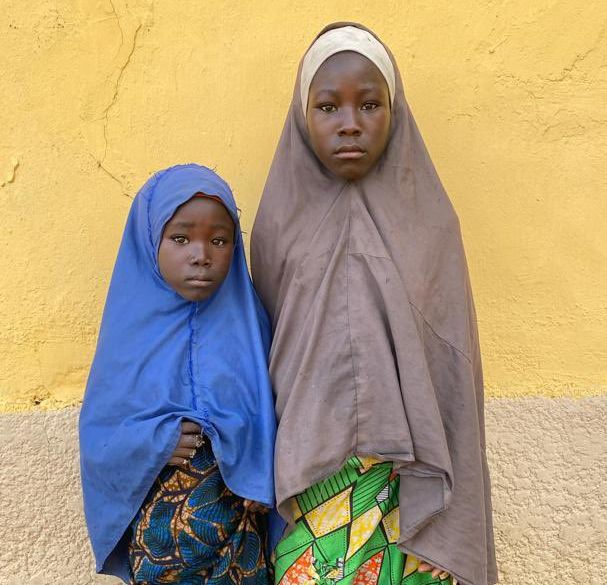
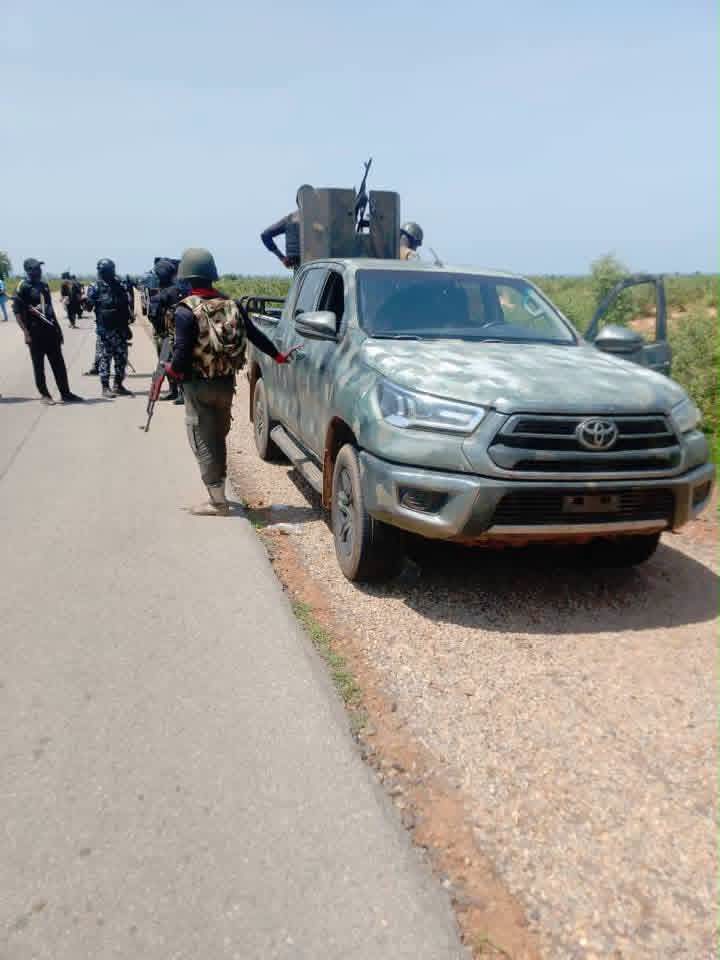
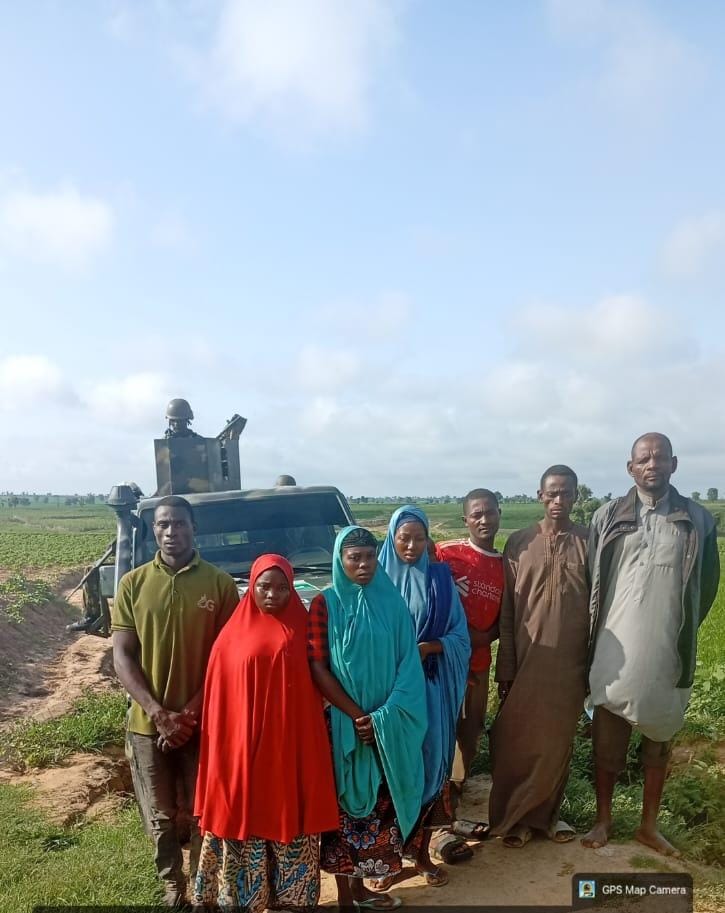
Two girls believed to be family members of Boko Haram terrorists have escaped from an insurgent enclave in the Mandara Mountains and surrendered to troops of Operation HADIN KAI in Gwoza Local Government Area of Borno State.

Intelligence sources told security analyst Zagazola Makama that the girls turned themselves in at about 3:55 p.m. on Tuesday, July 21, 2026, to troops of C Company, 192 Battalion (Mechanised), deployed in Gwoza.

Preliminary investigations revealed that the girls fled from Grazah, a terrorist enclave in the Mandara Mountains, before making their way to the military position. Military sources said the minors were received, screened, and documented in line with established operational procedures.

They are currently in the custody of the 192 Battalion for further profiling and appropriate administrative action.

The surrender is the latest in a series of escapes and voluntary surrenders involving women and children from terrorist enclaves in the North-East. Military authorities attribute the trend to sustained operations that continue to put pressure on insurgent strongholds.

According to the military, the general security situation across the theatre remains calm but unpredictable. Troops, it added, are maintaining high morale and operational readiness while sustaining offensive operations against Boko Haram and ISWAP elements.

Troops Rescue 27 Kidnapped Victims In Sokoto And Zamfara Operations

Troops of Operation FANSAN YAMMA have rescued 27 kidnapped victims and foiled several abduction attempts during a series of operations in Sokoto and Zamfara States. The troops also recovered rustled livestock and motorcycles during the operations.

This was disclosed in a statement issued by the Spokesman of Operation FANSAN YAMMA, Lieutenant Colonel Aliyu Danja.

According to the statement, troops deployed at two Forward Operating Bases acted on credible intelligence and moved swiftly to Wanke and Kaura communities in Shagari Local Government Area of Sokoto State. During the operation, six kidnapped victims were rescued. Troops also recovered livestock and two motorcycles. The rescued victims have since been reunited with their families.

In a separate operation, troops of Combat Team 12 responded promptly to a distress call along the Gummi–Sokoto road after terrorists blocked the highway in an attempt to abduct commuters. The troops engaged the attackers and pursued them, leading to the rescue of 11 kidnapped persons.

The military said operations are ongoing to clear terrorist hideouts and ensure the safety of residents along major highways in the North West.

From The Streets Of Kampala To The FIFA World Cup: The Ghetto Kids’ Journey To The Global Stage

What began as energetic dance videos on the streets of Uganda has now taken the Ghetto Kids all the way to the FIFA World Cup stage in the USA. The Ugandan dance group shared the spotlight with global stars Shakira and Burna Boy, a moment that proves talent truly has no boundaries.

Their rise is a powerful reminder of Proverbs 18:16: _”A person’s gift makes room for them and brings them before great people.”_ Who would have imagined that children once known for viral dance clips in Kampala would one day catch Shakira’s attention and perform on one of the world’s biggest stages?

The Ghetto Kids’ story is proof that your background does not define your future. With consistency, discipline, and belief in their gift, they have gone on to inspire millions worldwide. Congratulations to the Ghetto Kids — your journey continues to show the world what’s possible.

Fire Razes 17 Shops In Lagos Market 

0

A fire outbreak in the early hours of Tuesday destroyed 17 containerised shops at Sabo Market, Ikorodu, Lagos State.

According to the Lagos State Fire and Rescue Service, a distress call was received at 12:42 am on *July 21, 2026. Firefighters from Ikorodu and Ijede Stations arrived at the scene 12 minutes later, at 12:54 am.

The fire had engulfed 17 lock-up shops out of a row of about 30. The affected shops were located on a 648-square-metre section of land within a 1,944-square-metre premises.

Officials said the quick intervention of firefighters prevented the flames from spreading to adjoining shops and other properties in the market.

“No casualties or injuries were recorded during the incident,” the agency confirmed in a statement signed by Margaret Adeseye, Controller General of the Lagos State Fire and Rescue Service.

The cause of the fire is currently under investigation.

FIFA Launches Disciplinary Probe After Post-Match Clashes In World Cup Final

FIFA has opened disciplinary proceedings following ugly post-match scenes in Sunday’s World Cup final between Spain and Argentina.

Substitute Ferran Torres emerged as the hero for La Roja, scoring in the 106th minute of extra time to break a 0-0 deadlock and secure Spain’s second World Cup title. The goal denied Argentina a chance at back-to-back championships.

But the celebrations were overshadowed by clashes on the pitch at full-time.

Video footage showed Argentina’s Leandro Paredes and Nahuel Molina appearing to strike Spain’s Eric García and Rodri. Argentina coach Roberto Ayala was also seen in an altercation with Spain’s Dani Olmo.

In a statement, FIFA confirmed it has appointed a Disciplinary and Ethics Prosecutor to review the incidents.

“Following an assessment of the relevant match reports for the FIFA World Cup final between Spain and Argentina, and in line with Article 36 of the FIFA Disciplinary Code, the FIFA Disciplinary Committee has appointed a Disciplinary and Ethics Prosecutor to investigate potential breaches of the FDC with regard to the post-match incidents,” FIFA said.

“Further details will be communicated by the FIFA Disciplinary Committee once the prosecutor’s report has been completed.”

The governing body has not yet indicated what sanctions, if any, could be imposed. The outcome of the prosecutor’s report will determine whether players and staff face fines, suspensions, or other disciplinary action.

25 Years After 9/11: Construction Begins On 2 World Trade Centers

The 1,226-ft tower will complete the rebuilt World Trade Center skyline and house American Express’ global headquarters

Construction is officially underway on 2 World Trade Center, the most anticipated tower yet in Lower Manhattan’s rebuilt complex.

At 1,226 ft / 373.7 m and 55 stories, the new supertall will complete the World Trade Center skyline nearly 25 years after 9/11. Developed by Silverstein Properties, it is set to open in 2031 and will serve as the *new global headquarters for American Express, with space for roughly 10,000 employees across 2 million sq ft / 186,000 sq m of office space.

2 World Trade Center has had one of the most complex development histories in NYC.

The project was first designed by Foster + Partners, then handed to Bjarke Ingels Group, before Foster + Partners was brought back to deliver the final design.

The wait may pay off. In a city full of glass boxes, the tower is designed to stand out. Its stepped form features multiple terraces and integrated greenery that connect visually to the trees at street level around the memorial.

While the official groundbreaking was held earlier this month, work on 2WTC actually started in 2008. The foundation was completed in *2013*, and construction is now ramping up in full.

“This is not just a significant step forward for Lower Manhattan, but an inspiring demonstration of New York’s strength and resilience,” said Kathryn Garcia, Executive Director of the Port Authority, at the ceremony attended by city and federal officials.

“This investment by American Express advances our shared goal of completing the restoration of the World Trade Center as a site that supports commerce, remembrance, culture, community, transit and tourism for all the world to see.”

2 World Trade Center is the final commercial tower planned for the site. It joins:

– One World Trade Center – the tallest building in the U.S.

– 3 World Trade Center – office tower

– 5 World Trade Cente – the site’s only residential building

With its terraces, scale, and anchor tenant, 2WTC is positioned to be both a commercial landmark and the closing chapter in one of New York’s most symbolic rebuilds.

Meet Sheila Ebana, Yamal’s Mum Who Worked At McDonald’s So Her Son Could Play Football

0

Lamine Yamal is lighting up world football. But behind the 18-year-old Spain star is a story of sacrifice that starts with his mother, Sheila Ebana.

Born in Bata, Equatorial Guinea, Sheila moved to Spain as a teenager searching for a better life. Years later she became a mother to Lamine. She and Lamine’s father, Mounir Nasraoui, separated when he was 3. But both stayed present in his life.

Life wasn’t easy. To provide for her family, Sheila worked as a waitress and cook at a McDonald’s in Mataró.

When she saw how much Lamine loved football, she made another sacrifice. At age 4, Lamine was playing for CF La Torreta. To make training and matches possible, Sheila requested a transfer to a McDonald’s in Granollers, closer to the club.

She worked long hours. Money was tight. But she never missed a chance to support her son.

Lamine has never been shy about giving her credit.

“I never lost respect for my mother,” he once said. “She’s the one who always speaks, and when my mother speaks, everyone listens.”

That belief carried him from local pitches in Catalonia to Barcelona’s academy, and now to the Spain national team.

As Lamine’s career has exploded, fans have also gotten to know Sheila.

Today she has built a large following on social media, where she shares family moments with Lamine and his younger half-brother, Keyne.

From Bata to Mataró to watching her son play for Spain — Sheila Ebana’s journey is a reminder that behind every young star, there’s often a parent who refused to give up.

Lamine Yamal: Messi Inspired Me, Even In Defeat He’s A Champion

Lamine Yamal paid tribute to Lionel Messi after Spain’s 1-0 extra-time win over Argentina in the FIFA World Cup final on July 19, 2026.

The 18-year-old came on as a substitute and assisted the winning goal. But after full-time, his focus was on the man across the pitch.

“Tonight I lifted the World Cup for Spain, but I also experienced something I’ll tell my children one day. The man who once held me as a baby was standing on the other side of the pitch, fighting for the same dream. Football has a beautiful way of bringing stories full circle.”

Yamal was referencing the viral 2007 photo of a 20-year-old Messi bathing a 6-month-old Yamal during a charity calendar shoot at Barcelona.

“When I looked at Messi after the final whistle, I didn’t just see an opponent. I saw the player who made millions of kids, including me, believe football could be art. I saw the man whose videos I watched over and over, trying to copy things that nobody else could do.”

“I know this defeat will hurt him. You don’t play with that much passion, carry your country again and again, and lose a World Cup final without feeling pain. Even in defeat, he kept demanding the ball, creating chances and refusing to stop believing. That’s what champions do.”

“People will talk about Spain winning this World Cup, and they should. But they’ll also remember that, at an age when most legends have already retired, Messi was still making the world’s best defenders panic every time he touched the ball. That’s extraordinary.”

“The photo of Messi bathing me became one of football’s most iconic images. Today we took another picture together, but this time I could thank him face to face. Without players like him, kids like me wouldn’t dare dream this big.”

“One day another generation will replace mine too. That’s football. But there will never be another Lionel Messi. Records can be broken and trophies can be won, but inspiring an entire generation to fall in love with the game is something only a few people in history will ever achieve.”

“Tonight belongs to Spain. Tomorrow, the debates will continue. But my respect for Lionel Messi will never change. He didn’t need to win this final to prove who he is. For me, he’ll always be one of the greatest players football has ever seen, and sharing the pitch with him was a privilege I’ll carry for the rest of my life.”

From The Sahara To World Cup Glory: The Story Of Nico Williams

In the early 1990s, Nico Williams’ parents left Ghana with almost nothing. Their goal was simple: find a safer, better life for their family.

To get to Europe, they crossed the Sahara Desert on foot. By day they faced searing heat. By night, freezing cold. There was hunger, thirst, and constant danger.
The journey was even harder because Nico’s mother was pregnant with his older brother, Iñaki. Still, they kept walking. They believed their children deserved a future.

After weeks on the road, they reached Melilla, Spain’s enclave in North Africa. The family later settled in Spain’s Basque Country. There, Iñaki and Nico were born and raised. Football became their escape. Both brothers worked relentlessly to turn that love into a career.

Years later, Nico emerged as one of Spain’s brightest talents. His pace, skill, and drive earned him a place with La Roja.

On July 19, 2026, Nico lived the moment his parents dreamed of.
He came off the bench in the FIFA World Cup final against Argentina. In extra time, he delivered a brilliant assist to Ferran Torres, who scored the match’s only goal. Spain won 1-0 to lift the trophy.

For Nico, it was more than a winner’s medal.
“From crossing the Sahara barefoot to lifting the World Cup,” his story is about courage, sacrifice, and refusing to quit.

A dangerous desert crossing in the 90s led, three decades later, to a World Cup winner born in Bilbao.

How A Broadcaster Helped The 1976 Coup And Paid With His Life

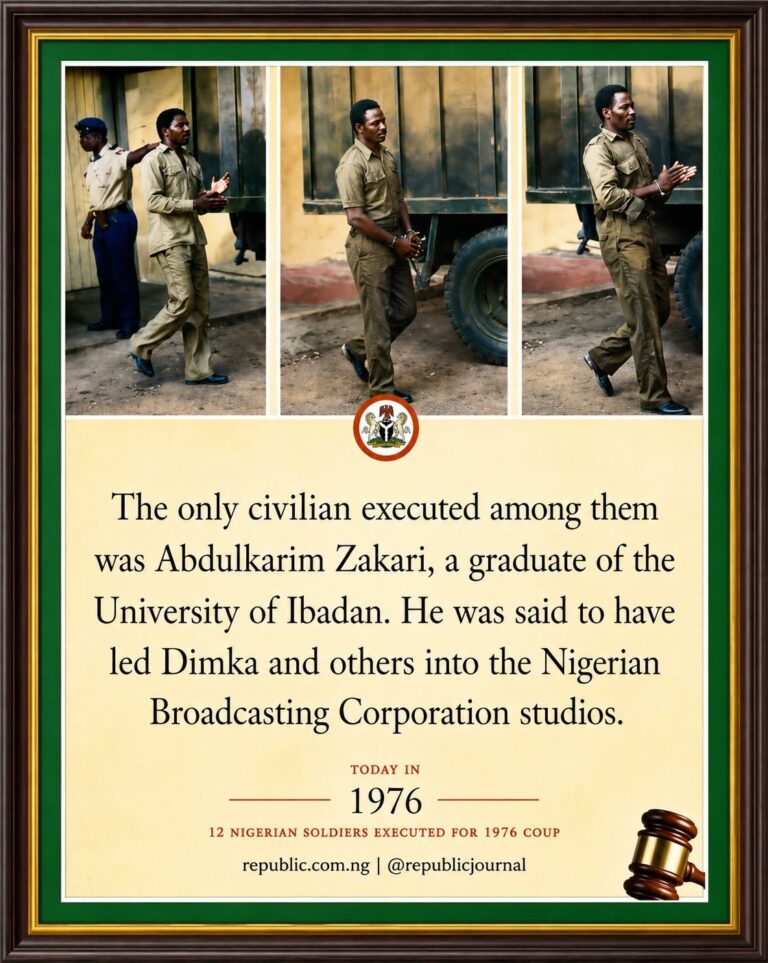
Abdulkarim Zakari was a Nigerian broadcaster and the only civilian executed for his role in the failed military coup of February 13, 1976, that led to the assassination of Head of State, General Murtala Muhammed.

A graduate of the University of Ibadan, Zakari worked as a senior radio journalist with the Nigerian Broadcasting Corporation, NBC. He was also the elder brother of Victoria Gowon, wife of former Head of State, General Yakubu Gowon, who had been ousted in a bloodless coup seven months earlier.

On the morning of the coup, plot leader Lt. Col. Bukar Suka Dimka needed urgent access to the NBC studios in Ikoyi, Lagos, to announce the overthrow of the government.

Using his credentials as a senior staff member, Zakari bypassed military security. Once inside, he:

Ushered Dimka into the live studio for the dawn broadcast

Cleared non-essential staff and set up the transmission lines

Sourced and looped martial music between announcements to signal a change of government

At about 6:30 AM, Dimka announced on air that General Murtala had been assassinated and declared a nationwide curfew.

After the coup collapsed hours later, Zakari was arrested and tried alongside senior military officers by a Special Military Tribunal chaired by Maj. Gen. John Obada.

The prosecution argued Zakari’s actions amounted to high treason. Two key pieces of evidence were presented:

Phone records showing he met with Dimka days before the coup, contradicting his claim of acting under duress

Soldiers’ confessions stating his goal was to control NBC’s broadcast until General Gowon could be contacted in London

On March 11, 1976, Zakari was executed by firing squad at Bar Beach, Lagos. He was tied to a stake and shot alongside 30 military officers, including Maj. Gen. Iliya Bisalla, the Federal Commissioner for Defence. The execution was carried out publicly before thousands of spectators.

Zakari’s involvement remains significant for three reasons: his status as a civilian, his use of the media to aid a coup, and his family link to Nigeria’s ousted leader.

The military regime said the public execution was meant to send a strong message against civilian collaboration in military takeovers.

Zakari’s story is a stark reminder of how control of information became a weapon during Nigeria’s turbulent years of military rule.

Mbappe Wins Second Golden Boot, Becomes World Cup Top Scorer

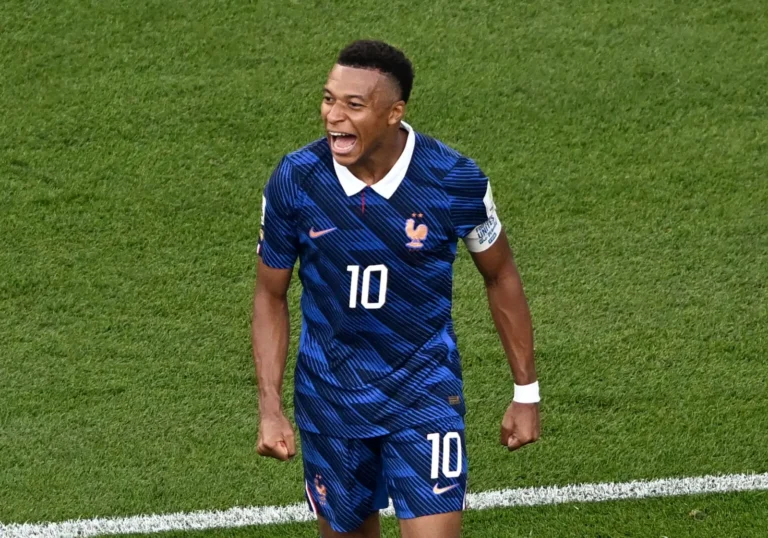
French superstar Kylian Mbappe has made World Cup history after becoming the first player to win the Golden Boot twice, finishing as top scorer at the 2026 tournament in the United States, Mexico and Canada.

The Real Madrid forward scored 10 goals in eight matches to beat Argentina’s Lionel Messi to the award. It adds to the Golden Boot he won in Qatar in 2022 with eight goals.

At 27, Mbappe also became the first man to reach double figures at a single World Cup since Gerd Muller for West Germany in 1970. He sealed the record on Saturday with a brace in France’s 6-4 defeat to England in the third-place playoff in Miami, a result that saw Les Bleus finish fourth.

The two goals moved Mbappe clear at the top of the men’s all-time World Cup scoring chart with 22 goals — one ahead of Messi.

“When you score that many goals in the World Cup, it certainly takes you to a whole new level,” Mbappe said after the match.

“But I would have preferred not to be the top scorer and to have played in the final. It’s good for my legacy once I’ve retired, but right now, that’s not what’s on my mind.”

The Betrayal Of DSP George Iyamu: The Police Officer Who Worked With Lawrence “The Law” Anini

In the mid-1980s, fear gripped southern Nigeria. At the center of it was Lawrence Anini — a notorious armed robber so bold he called himself “The Law.” And standing beside him, in one of the country’s darkest chapters of police corruption, was a man sworn to stop him: Deputy Superintendent of Police George Iyamu.

George Iyamu was a senior officer in the Nigerian Police Force, stationed in Benin City, the capital of the then Bendel State — today’s Edo and Delta States. This was a period when armed robbery was at its peak and public trust in the police was at an all-time low.

Anini and his gang terrorized banks, highways, and even police stations across the region. They carried out brazen robberies, ambushed security operatives, and left mocking notes at crime scenes. To some desperate citizens, Anini even gained a twisted, Robin Hood-like reputation.

For months, authorities couldn’t catch Anini. The reason became clear after his arrest in late 1986: he had help from inside.

Investigations revealed that DSP George Iyamu was secretly part of Anini’s inner circle. Instead of enforcing the law, he was undermining it.

According to confessions and court records, Iyamu:

Leaked police intelligence tipping Anini off about troop movements and roadblock locations

Supplied weapons and ammunition to the gang

Shielded the criminals by using his position to help them evade arrest

Iyamu wasn’t just corrupt. He was a mole, and his betrayal explained how Anini managed to operate so freely for so long.

In 1986, under pressure from the military government of General Ibrahim Babangida, the police launched a nationwide manhunt. Anini was eventually tracked down and arrested in a dramatic operation led by Superintendent Kayode Uanreroro. He was shot in the leg and left paralyzed.

During interrogation, Anini named names. When he revealed Iyamu’s role, the nation was stunned. A senior police officer had been working with Nigeria’s most wanted criminal.

Both Anini and Iyamu were tried and found guilty of armed robbery, murder, and conspiracy.

On March 29, 1987, they were executed by firing squad alongside other members of the gang.

The case of George Iyamu remains a painful reminder of how corruption within law enforcement can embolden crime. It also marked a turning point — forcing a national conversation about accountability and reform in the Nigerian Police Force.

Nigerian Bar Association Requires Critical Retooling, By Chidi Odinkalu

The history of the Nigerian Bar Association (NBA) parallels the country’s political evolution. It began in 1900, the same year in which Queen Victoria’s British colonial government assumed formal authority over Nigeria after revoking the Royal Charter of Taubman Goldie’s Royal Niger Company.

For the next 59 years, leadership of the NBA was a lifetime preferment. Christopher Sapara Williams became Nigeria’s first lawyer in 1888. Twelve years later, he emerged as the first Chairman of the national bar. Sapara Williams served in that role until his untimely death in 1915. His successor was acclaimed colonial collaborator, Sir Kitoyi Ajasa. Like Sapara Williams, Sir Kitoyi served until he died in 1937. He holds the record as the longest-serving national leader of the NBA.

Olawolu Eric Moore succeeded to the role until his death in 1944. Eric James Alex Taylor – whose son, John Idowu Conrad, would later become the founding Chief Justice of Lagos – followed and died in that position in 1950. His successor, Adeyemo Alakija, did the same in 1952. Alhaji Jubril Martins, the sixth chairman of Nigeria’s national bar, died in June 1959.

The emergence of Frederick Rotimi Alade Williams as the first President of the NBA coincided with the arrival of independence in 1960. With a tenure that lasted until 1968, Chief Williams is the longest-serving president in the history of the association. Since the three-year tenure of Richard Akinjide from 1970-1973, no president of the association has held office for more than two years.

In the tradition of the NBA, it is assumed that the association invests the president with authority. Occasionally, the weight of the association has been advanced by the authority of a charismatic president with moral authority. One example was the presidency of Alao Aka Basorun during the military regime of Ibrahim Babangida from 1987 to 1989. Olisa Agbakoba arguably did the same from 2006 to 2008 in the fraught transition from the administration of Olusegun Obasanjo to the flawed mandate of Umaru Musa Yar’Adua.

Since 1960, the NBA has had 32 presidents. In the third week of July 2026, the association will elect its 33rd president. The mission of the association’s president is encapsulated in its motto: “promoting the rule of law.” Yet, from its very beginning, this has been a fraught mission.

The first two leaders of the NBA illustrate two different ideological pathways that have framed the association’s mission. Sapara Williams was regarded as radical, with a reputation for confronting white arrogance. He defended the rights of natives, argued for freedom of expression and was the father of “restructuring.” In 1904, he reportedly proposed to Lugard that “the present boundary between the Colony and Protectorate of Southern Nigeria and the Protectorate of Northern Nigeria be readjusted by bringing the southern portion into Southern Nigeria, so that the entire tribes of the Yoruba-speaking people should be under the same administration.”

By contrast, his successor, Kitoyi Ajasa, made his career as a collaborationist in the colonial subjugation of natives. A close confidante of founding Governor-General Frederick Lugard, Sir Kitoyi was also seven-time Worshipful Master of the Lagos (Masonic) Lodge No. 1171 between 1901 and 1928.

These themes of confrontation and collaboration have been durable in the politics of the NBA to the present day. As the country’s political economy has evolved and the demographics and reach of the bar have ramified, the factors that now define leadership at the Nigerian Bar and its orientation have also adapted, presenting the association with a third possibility – pragmatism.

In 2016, the association re-designed its leadership selection processes in three ways that are somewhat in tension with one another. One was the introduction of universal suffrage. The second was the emergence of ethno-tribal politics in the NBA. The third was the introduction of digital balloting. There is a fourth issue, which is the role of money in leadership selection in the association. A fifth is the role of outside interests and politically exposed persons. These five issues will require attention in the years ahead if the NBA is to retain both relevance and salience in the country’s affairs. It is useful to advert to each briefly.

First, the replacement of the much-maligned delegate system with universal suffrage privileges the young lawyers among whose population the most votes lie. The goal was to force senior lawyers to take their obligations to younger lawyers more seriously, in the knowledge that if they do not, their ambitions could be punished through rejection by the younger lawyers. The exponential growth in the population of lawyers in the country creates a need to improve data management capabilities. The association has made progress, but it still has considerable room for improvement.

Second, the NBA formalized the rotation of its most important positions across the three original regions of the country. In the shorthand of Nigerian politics, this is known as “zoning”.  At its best, it is an acknowledgement of the country’s ethnic diversity. At its worst, it is a genuflection before the gods of grubby ethno-tribal politics. The original design is that while ethnic cabals may be needed to bless leadership ambitions, those ambitions ultimately have to be acceptable to a broad majority of the association’s membership to succeed. In the contest for the leadership in #NBADecides2026, one candidate turned this engineering of political convention into a destructive weapon of political entitlement with backing from forces who inveigled the Attorney-General of the Federation into endorsing this in principle. It took the Court of Appeal to – momentarily – save the day.

Third, the migration of balloting to digital platforms has created its own problems. The twin bugs of energy and bandwidth hunger have sustained a deficit of belief in the integrity and administration of the NBA’s election systems. In successive cycles since 2018, voting has been afflicted by growing allegations of cyberattacks. In the latest cycle, voting had to be delayed by over seven hours because of what the Electoral Committee of the NBA (ECNBA) called “a coordinated cyberattack on its electronic voting platform.” This cannot be condemned too seriously, but it was entirely foreseeable and reveals a failure of adequate stress-testing and firewalling ahead of the balloting. The organs of the NBA have a duty to now institutionalise effective and transparent post-ballot forensics in order to adapt ballot administration to the rapid changes in digital capabilities. It seems clear that this will be a site of vigorous contest in the aftermath of the current ballot.

Fourth, since at least 2014, the contest for leadership of Nigeria’s legal profession has become a liquidity derby. In that year, expenditure on the campaign for the presidency of the association broke the one billion Naira barrier. It has been on the rise since then. The pay-off is significant because the NBA is a multi-billionaire organization and its leader commands real powers of both access and patronage.

But the result is also that the candidates have to raise campaign funds from sources outside the association. In many cases, this puts them in hock to politically exposed persons (PEPs) who control the largest war chests in Nigeria. The accompanying bargains, even when implicit, can undermine the commitment of the association to “promoting the rule of law.” The responsibility to rein in this runaway inflation in the costs of associational politics in the NBA belongs to the ECNBA. A succession of leaders of the electoral umpire have, however, capitulated on this issue. That must change.


The road to the ballot in #NBADecides2026 has encountered more obstacles than a demolition derby. The contest is unlikely to end with the announcement of a winner on 19 July 2026. The outcome may end up in the courts yet again. Howsoever it ends, the association must confront, with bold transparency, the duty to continuously improve the administration of its leadership processes. It must also understand that failure to do so will endanger its commitment to promoting the rule of law. This is not an option as the country confronts a bumpy election year in 2027.

A Lawyer And A Teacher, Odinkalu Can Be Reached At chidi.odinkalu@tufts.edu

Trump’s Threats, U-turn On Hormuz Fees Further Undermine US Credibility, By Marc Weller

International law does not permit any country to appoint itself ‘guardian’ of other states’ rights and demand payment. The only realistic solution to the situation in the Strait (of Hormuz) is a return to negotiations.

On 13 July, President Donald Trump appointed the United States the ‘Guardian’ of the Strait of Hormuz. The US would ensure passage through the Strait, he announced, but would ‘as a matter of FAIRNESS’ demand a payment of 20 per cent of the value of the cargo carried by each passing vessel.

This could be up to US$30 million per passage for a large oil tanker – an exorbitant amount and 15 times the sum Iran has reportedly demanded in tolls. It would be a reimbursement ‘for any and all costs necessary to do the job of providing safety and security to this very volatile section of the world,’ Trump added.

The president matched this announcement in the same post by re-imposing the US blockade of Iranian vessels and maritime traffic destined for Iran. In response, Iran confirmed that it would close the Strait again. In essence, this means that shipping has returned to the status it had before the ceasefire agreed by the US and Iran in the Memorandum of Understanding (MoU) of 17 June.

Of course, international law does not allow any country, however powerful it may be, to appoint itself ‘guardian’ of the rights of all other states and demand payment for such unsolicited protection. And the president’s move contradicted the statements of his senior officials, undermining US credibility in the region.

On 14 July, a new post by the president appeared to reverse his position, saying that he had decided to replace the reimbursement fee ‘with Trade and Investment Deals that the various Gulf States will be making into the United States.’

This U-turn will not undo the damage his fees threat has done to trust in the US, and to its supposedly principled position in defence of free maritime transit through international straits.

Meanwhile, the only viable solution to restoring shipping in the Strait of Hormuz remains a negotiated settlement – a prospect made even more difficult by the risk of further escalation of the renewed military conflict.

In the MoU, the US surprisingly conceded that Iran would restore freedom of navigation without charge ‘for 60 days only’. Afterwards, the MoU stated that Iran and Oman would ‘define the future administration and maritime services’ in relation to the Strait.

The MoU referred to international law and the interests of other Gulf states. But it also emphasized the ‘sovereign rights of coastal states in the Strait of Hormuz.’ Iran might be forgiven for thinking that by agreeing to this language, the US had caved in to its demand for control over the Strait. It has certainly behaved as if it does.

It is true, every coastal state enjoys sovereign rights over its territorial seas up to 12 nautical miles from its coast. However, where a strait used for international navigation traverses the territorial sea of any country, that state must grant unhindered passage to shipping of all flag states.

There is therefore no room in international law for Iran’s attempts to extract tolls, or for a similar and even more exaggerated attempt by the White House.

Iran persists in its claim to have moved the Strait’s sea lanes northwards, closer to its coastline and falling still further within its territorial waters.

But the original routing through the middle of the Strait was agreed as far back as 1966 with the International Maritime Organization (IMO) – the actual guardian of maritime freedoms – and cannot simply be changed by one state at the expense of all shipping nations.

The US and Oman, with the involvement of the IMO, responded to Iran’s claim by moving the sea lane south-wards, hugging the Omani coast and mainly traversing its territorial waters. Iran has tried to oppose this US attempt to reduce its power over passage by mounting occasional missile and drone attacks against shipping seeking to use the US/Omani route.

Last week, Oman hosted negotiations on this issue, supported by mediation from Qatar and others and legal drafting from Europe. A compromise would have been obvious: to return to the approved, original sea lane towards the middle of the Strait.

To facilitate this, experts supporting the negotiations proposed a compromise on the ‘Malacca Strait model.’ In that busy shipping route, coastal states do not collect tolls merely for passage. Instead, a reasonable fee is collected for pilotage and perhaps the provision of navigational aids and other services, with the approval of the affected maritime states.

Control over this arrangement could be exercised by a joint Iranian and Omani body, perhaps with some international representation. It would ensure that the fees remain proportionate to the services rendered and that the scheme is administered without discrimination, for instance against ‘hostile flag-states,’ which might include Israel or the US.

However, Iran remained intransigent in the negotiations, and no agreement was reached.

President Trump’s proposal to levy vast and disproportionate fees on shipping appeared once again as if the US was seeking to make money out of an emergency suffered by others, including those desperate for the importation of oil and fertilizers. In that respect, it was reminiscent of the minerals agreement pressed onto Ukraine last year.

The president’s fees announcement was immediately opposed by the IMO, which emphasized that it opposes all charging of mandatory fees for passage through straits used for international navigation. Trump’s reference to the fact that Iran started this crisis by demanding tolls is not relevant. The fact that someone observes another stealing a car does not authorize that observer to steal one as well. And ultimately this crisis was brought about by the US and Israeli attack on Iran in February, in the first place.

The Trump scheme was not realistic and clearly met stiff resistance from Gulf states, further undermining the White House’s diplomacy in the Gulf. Secretary of State Marco Rubio stated in June, referencing international law, that no toll would be allowed for passage through the Strait.

Trump’s governance, by Truth Social has undercut this position yet again. His almost immediate change of heart highlights how capricious the US president remains and how little can be invested in the statements of his most senior diplomatic officials. Trump’s backing down from an attempt to impose fees avoids further damage to maritime freedoms on the part of the US – but it has certainly further eroded US credibility. This will also weaken the US position in opposition to Iran’s demand for tolls. After all, the US president had demanded them fifteen-fold.

Some form of row back on the president’s statement was inevitable. His plan was unlawful and pure fantasy. Ships would have faced considerable risk in making a passage of the Strait opposed by Iran, even under US protection. Few ship owners would have risked vessels, cargo and crew in a narrow sea lane under constant threat of Iranian attack or mines.

Moreover, a charge of anything like 20 per cent of the value of the cargo would not have been a commercially viable proposition for the ship owners and their clients. The Gulf states and their offer of investments give Trump cover and an excuse for a rapid retreat from his unsustainable position.

However, this leaves the situation in Hormuz uncertain, as US-Iran hostilities escalate and maritime traffic slows once again.

It is now time for the grown-ups to intervene more decisively. The only realistic approach for a solution must lie in the resumption of negotiations to regulate shipping through the Strait and to return to a ceasefire.

Other countries such as China could make a significant contribution by finally applying pressure in favour of restoring the maritime freedoms on which they also depend.

There can be no Iranian control of passage or tolls. But there can be a face-saving arrangement for limited fees charged in proportion to expenses made in assuring safety of navigation, protection against environmental damage, and other reasonable expenses. And Europe, with leadership from the UK, can take a role in securing freedom of navigation once a deal is finally done – without seeking to impose a charge upon the world in consequence.

Prof. Marc Weller Is Director, Global Governance And Security Centre, International Law Programme, Chatham House.

If The 2027 Elections Must Be Credible… 1, By Bolanle Bolawole

I once advocated that we create a Ministry or agency charged with the responsibility of harnessing ideas canvassed at public speakings such as book launches or presentations, inaugural and other lectures, among others; the reason being the robust ideas traded at such fora that will, undoubtedly, enrich public discourse and help accelerate national development. I doubt if anyone in the government gave serious thought to the proposal.

And for not doing so, we miss a lot and lose a lot. We grope in the dark and fall into the same errors again and again. It is trite that ideas rule the world. Every invention is an idea brought to fruition. Little wonder, then, that it is said that if you can think it, you can do it. But what happens where thinkers are ignored and thoughts that can elevate us perish without anyone in authority reaching out for them?

Recently, I graced three events where profound ideas that can positively impact our lives and country were discussed: One was a birthday celebration; the second, a book presentation and launch of a let-project; and the third, another book presentation-cum-launching of an endowment fund for indigent students. Do you think Nigerian leaders are men and women of ideas? Gone were the days when ideas and political manifestos defined our politics. No more!

Today, our politics – and governance itself – is governed by money politics and thuggery. People with ideas have been muscled out of reckoning and packed in a corner to amuse themselves with their ideas! As they say in popular, streetwise parlance, to hell with you if you say you have ideas but aren’t a money-bag!

Goodluck Jonathan’s 2014 confab

At Bishop David Esosa Ize-Iyamu, General Overseer, Jesus Evangelical Assembly’s 60th birthday lecture held on Thursday, June 4, 2026 at his church premises off Allen Avenue, Ikeja, Lagos, the lecture delivered by Wole Oladiyun, founder/senior pastor of the Christ Livingspring Apostolic Ministry (CLAM) was a treasure. Variously described as “preacher, pastor, apostle, prophet, Christian author of over 50 books, civil engineer and entrepreneur”, Oladiyun did not disappoint. As I sat listening to him, I wondered if there was anyone in the audience that could translate his ideas into action!

Men of ideas are ignored in Nigeria – and it can be very frustrating if you are one of such men and women. I recall how the 2014 Movement used to meet at this same Bishop Ize-Iyamu’s church, burning with the zeal to have the recommendations of the 2014 confab of President Goodluck Jonathan actualized to give birth to a better Nigeria. But it was an uphill task.

Those who have hijacked Nigeria and its destiny will not cede an inch of the country’s territory to men and women of ideas who seek to liberate and take it to greater heights. I saw some of our 2014 Movement members in the audience at the 4th June event. Those days, the humility, magnanimity, and generosity of Bishop Ize-Iyamu knew no bounds. But what a great opportunity Jonathan. missed to etch his name in gold in the annals of history!

Honour to whom it is due

The second event was the book launch – his seventh – by my professional colleague and brother, Ademola (Demola) Akinbola and the inauguration of his pet-project, the Nigerian Brand Academy, which took place at the GRA, Ikeja, Lagos on Thursday, June 15, 2026. The title of the book is “Communicating to WIN in career and business.”

Am I surprised at the ingenuity, hard work and industry of Demoo, as I fondly call him? Not at all! Those were the same qualities that informed my head-hunting him to co-lead the Business Desk of The PUNCH when I became its editor in 1992 and the decision was taken to shift the newspaper’s focus from entertainment to a serious, business-friendly format. Demola and the others did not disappoint. So whatever PUNCH has achieved today in that respect, Demola was one of those who laid the foundation.

And it was not at PUNCH alone that Demola has demonstrated his stuff; he has done so everywhere he has worked – at Owena Bank (which later became Omegabank), at Prudent Bank and even at Oladiyun’s CLAM where he worships. So, at Demola’s event, his boss at Omegabank, Dr. Rotimi Adelola (who later became the Secretary to the Ondo State Government), was there. Akinsola Akinfenwa, his boss at Prudent Bank, was there. Oladiyun, who was unavoidably absent, sent a representative. And I, his boss at The PUNCH, was there.

Of course, the hall was jam-packed with media and public relations gurus, including the inimitable Bisi Olatilo of BISCOM Communications. Taking after a river that wouldn’t forget its source – and which shall never dry up – some of us were conferred with an “Award of Recognition … In appreciation of (our) outstanding contributions to the growth and development of Ademola Akinbola’s professional career.” And I ask him to soar higher!

Speak with your judgments

The third event took place in Abuja on Thursday, 2nd July, 2026; it was the public presentation of two books as well as the launch of the “Justice Alaba Omolaye-Ajileye Educational Foundation For Indigent Students.” The titles of the books were “Electronic Evidence, Second Edition (With Evidence Act, 2011) and “A Compendium Of Cases On Electronic Evidence (Volume II, 2020 – 2025).

A retired judge of the Kogi state judiciary and Professor of Law at the National Open University of Nigeria (NOUN), Abuja, Justice Omolaye-Ajileye is Nigeria’s leading authority in the new field of electronic evidence. Little wonder, then, that the hall was packed full with lawyers and judges, including an assemblage of justices of the Supreme Court that no one has seen before at such an event. Senior Advocates of Nigeria (SAN) were sending other SANs on errand, as it were! Judges of high courts, appellate courts, and leaders of the bar, including former presidents of the Nigerian Bar Association, and leaders of the Body of Benchers, graced the occasion.

The Director-General of DSS was there; he performed the unveiling of one of the books; so also was the chairman of the EFCC, who also performed the unveiling of the second book. That alone speaks of the quality of attendance at the event. The keynote address was delivered by Kanu Agabi, one of the NBA’s living legends. Agabi caused a stir with his address, and so did the DSS and EFCC bosses. Saying that the “charges against our judges demand answers” and “the indignities the judiciary as an institution is now tolerating are not personal (but) are aimed at the institution of the judiciary”, Agabi charged the judges to “answer the charges. These charges demand answers. Speak through your judgments.”

Turning in the direction of the DG, DSS and Chairman, EFCC, Agabi said: “I wish to say as I see the DG of the DSS and the Chairman of the EFCC sitting side by side: We have billions, hundreds of billions, abroad, and this generation will have failed if we don’t bring back those moneys. That is what we must do now. Please, however we do it, we must do it.”

The EFCC chairman picked up the gauntlet and asked whether he could start the process of recovering the country’s looted funds right there in the hall! Roaring laughter! He thanked Justice Omolaye-Ajileye for having used his scholarship to expand EFCC’s capacity to fight crimes, describing financial crimes as “one of the major problems we have in this country today.”

The DG DSS agreed, saying that the author’s pioneering work in the field of electronic evidence has been of immense benefit to those of them involved in prosecuting cases in our law courts. There was pin-drop silence in the hall when he made a veiled reference to politician-cum-activist, Omoyele Sowore, insisting that calling the president unprintable names should not be tolerated by lawyers and journalists alike.

Like Awolowo, like Omolaye-Ajileye

As told by him, Justice Omolaye-Ajileye’s decision to launch an educational endowment for indigent students has history behind it: “In I983 while I was preparing to attend the Nigerian Law School, my father lost his modest employment as a Road Overseer. At that time, he had eight other children who also required educational support at different levels. The situation was extremely difficult and my dream of becoming a lawyer was seriously threatened. I needed money to pay my Law School fees, including the cost of my wig and gown, but there was no money. Determined not to abandon my dream, I sought and obtained my father’s permission to look for a loan. By the grace of God, I found a benefactor who agreed to assist me. He gave me the money on the understanding that I would repay it after my graduation without interest. That singular act of kindness changed the course of my life. Without that timely intervention, only God knows what would have become of my educational and professional journey.”

He was lucky! The story is told of how the late sage, Chief Obafemi Awolowo, also at a stage in life sought a loan from a wealthy Yoruba industrialist to enable him proceed abroad for further studies, but he was denied! Notwithstanding, Chief Awolowo managed to achieve his ambition – and see what a blessing he later became not only to his Yoruba race (including the man who had denied him the loan he begged for) but to Nigeria as a whole and the generality of humanity! Imagine also the loss if Justice Omolaye-Ajileye had not been fortunate enough to access the much-needed loan and his educational and professional career had thereby been truncated!

I know of a destiny so truncated: Yusuf Adagbeje was the brightest lad in my primary school days. He was exceptionally good in Mathematics/Arithmetics. We finished school and everyone went their separate ways. Many years after, I was returning home from the NYSC camp, resplendent in my NYSC kits, and I hailed a taxi to take me home from the motor park. I settled down in the back of the car and adjusted myself. Along the way, the driver looked back to confirm where we were heading. Lo and behold, it was Yusuf Adagbeje! I screamed, “Yusuf!” He, too, screamed, “Ojo!” I asked him what he was doing; he explained that after primary school, there were no funds to send him to secondary school! So he learnt driving and was already a father of three. When I got to my destination, I offered him his fares but he declined.

Free education to the university level ought to be the right of every child. Its provision ought to be the duty of every responsible and responsive government. Once denied, individuals suffer, talents perish, destinies are destroyed and society’s progress or development as a whole gets stymied. So sad!

NEXT WEEK: Justice Omolaye-Ajileye’s recommendations for a credible 2027 elections.

turnpot@gmail.com 0705 263 1058

 

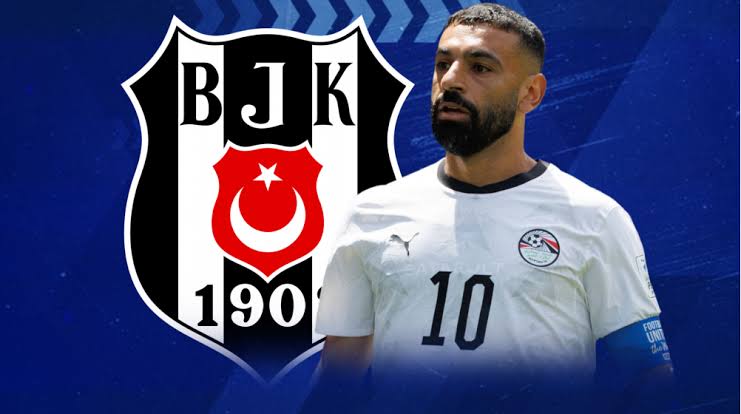
Mohamed Salah ‘Agrees Verbal Deal’ With Beşiktaş After Liverpool Exit

Former Liverpool forward Mohamed Salah has reportedly reached a verbal agreement to join Turkish giants Beşiktaş, following the end of his spell at Anfield.

According to reports, the Egyptian winger is set to sign a one-year contract with the Super Lig club, with an option to extend for a further year.

Under the proposed terms, Salah would earn a guaranteed annual salary of €10 million. Performance-related bonuses worth up to an additional €2 million could take the deal to a potential €12 million per year.

The agreement is described as verbal at this stage, with both parties said to be working on finalizing the details before an official announcement.

Salah, 33, ended his trophy-laden eight-year stint at Liverpool earlier this summer. Last season he made 41 appearances in all competitions for the Reds, scoring 12 goals and providing 10 assists.

The Egyptian is widely regarded as one of the Premier League’s greatest forwards and currently has an estimated market value of €22 million, according to Transfermarkt.

Beşiktaş are yet to confirm the deal.

Nigerian Woman Living In Canada Sets ‘Conditions’ For Husband’s Relocation

A married Nigerian woman based in Canada has sparked widespread discussion online after posting a public message outlining conditions she expects her husband to meet before she helps him relocate from Nigeria to Canada.

In the viral Facebook post, the woman, identified as Ezinne Maryjane Nwanorue, addressed her husband, Franklin Chimaobim Nwanorue, directly. She said she shared the message publicly after previous private discussions did not yield results.

According to the post, her conditions include marital faithfulness and commitment. She stated that she expects the marriage to be built on “love, respect, peace, trust, support, prayer and unity,” and emphasized that she is not willing to “labour in vain” after years of sacrifice to keep the marriage together.

She also warned of serious consequences should the agreement be broken, framing the terms as a directive she believes was given to her. The post further stated that she does not intend to accept a second wife in the marriage and that divorce is not an option.

The post, which included a photo of her husband, quickly drew reactions online with many users urging her to take it down. As of the time of this report, she has not deleted the post.

The story has continued to generate debate on social media about marriage, migration, and relationships in the diaspora.

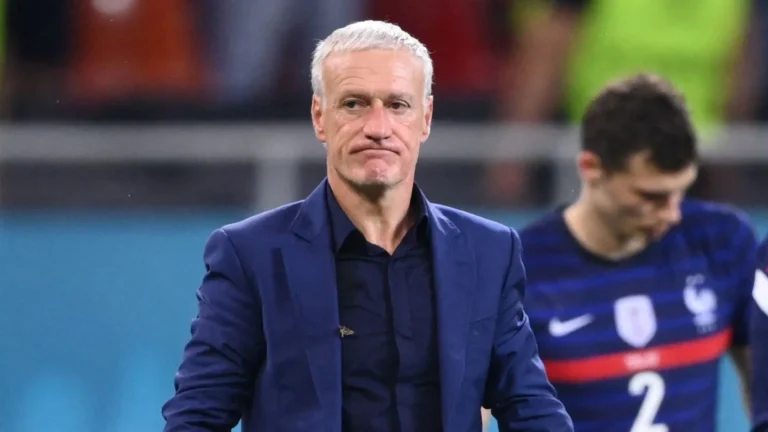
Deschamps Denies France Players’ Night Out Request Ahead Of World Cup Third-Place Clash With England

France coach Didier Deschamps has turned down a request from his players for a night off ahead of Saturday’s 2026 FIFA World Cup third-place playoff against England.

According to _L’Equipe_, members of the France squad asked for a free evening “to clear their heads” following their 2-0 semi-final defeat to Spain in Boston earlier this week.

However, Deschamps rejected the request, determined to keep the team focused as France look to avoid ending the tournament with back-to-back losses.

The Les Bleus traveled from their World Cup training base in Boston to Miami on Thursday ahead of the playoff at Hard Rock Stadium.

England also head into the match on the back of disappointment, having lost 2-1 to Argentina in their semi-final on Wednesday.

With both teams aiming to finish the tournament on a high, Deschamps is prioritizing discipline and preparation over downtime as France chase a podium finish in the 2026 World Cup.

Woman Arrested In Benue Over Alleged Killing Of Co-Wife’s Daughter

0

A woman, identified as Erdoo Nancy, has been arrested in connection with the alleged killing of her co-wife’s daughter in Ankyoor community, Gwer East Local Government Area of Benue State.

Eyewitnesses said the incident occurred along Makurdi Road, opposite YUA Guest House in the area. According to local accounts, youths in the community apprehended the suspect shortly after the incident and handed her over to officers at the Nigeria Police Force, Aliade Division.

Preliminary reports indicate that the alleged attack occurred while the child’s mother was away. The exact circumstances and motive behind the incident remain unclear.

The Benue State Police Command is yet to issue an official statement on the matter as of the time of filing this report. The suspect is currently in police custody and investigation is ongoing.

This is a developing story and will be updated with official details from the police._

Troops Rescue 9 Kidnap Victims, Recover 56 Livestock, Arrest Suspect In Katsina

Troops of the Joint Task Force North West, Operation FANSAN YAMMA, have rescued nine kidnapped victims, recovered 56 rustled livestock, and arrested a suspected terrorist in separate operations in Katsina State.

The military said the operations, conducted on intelligence, targeted bandit hideouts across the theatre and recorded significant gains between July 9 and July 17, 2026.

In Faskari Local Government Area, troops of Sector 2 on a fighting patrol rescued nine victims — three women, four men, and two children. Preliminary investigation revealed the victims were abducted on July 9, 2026 along the Tsafe–Kuchere Road in Tsafe LGA, Zamfara State.

According to the victims, they escaped when their captors fell asleep and were later intercepted by troops. The rescued persons are in safe custody and are being processed for reunification with their families.

In a separate operation in Bakori LGA, troops responded to a distress report of an attempted livestock rustling. The terrorists opened fire on sighting the troops but fled into the bush after being overwhelmed. They abandoned 56 livestock comprising 4 cattle and 52 sheep. The animals are in military custody pending handover to local authorities.

Also, troops arrested a suspected terrorist during routine operations in Danmusa LGA. Items recovered from the suspect are being analyzed and are suspected to have links with terrorist activities. The suspect remains in custody for further investigation.

The Theatre Commander of Operation FANSAN YAMMA commended the troops for their professionalism and resilience. He reaffirmed the Joint Task Force’s commitment to sustaining intelligence-driven operations in collaboration with other security agencies until terrorism and banditry are defeated in the North West.

How ₦7m Debt Piled Up As Family Fought To Save Alleged Rape Victim, Favour Agbro

0

Details have emerged on how the family of late Favour Agbro, the 20-year-old who died by suicide after alleging sexual assault by content creator Odogwu Asaaba, incurred a ₦7 million debt trying to save her life.

Speaking in a video interview on Thursday alongside the family’s legal counsel, Barrister Awele Ideal, Favour’s twin sister, Faith Agbro, said the debt came from emergency medical treatment sought as her sister’s health deteriorated.

“To save her life, we borrowed aggressively from different sources for her treatment,” Faith said. “Now, creditors are putting serious pressure on us for immediate repayment.”

The family briefing also addressed reports of a possible out-of-court settlement. Faith said that before her death, Favour had expressed a wish for leniency toward Asaaba, citing concern for his twin daughters. She added that their father has also shown some compassion toward the suspect because of the age of Asaaba’s mother.

Barrister Ideal confirmed that the suspect has made “lucrative” offers to the family in an attempt to have the case dropped. The lawyer, however, advised the family against accepting any settlement.

“Accepting any offer at this stage would compromise and truncate the ongoing judicial process,” Ideal warned.

Favour Agbro’s death sparked widespread reactions online, with calls for justice and for stronger support for survivors of sexual assault.

Police authorities have said investigations into the allegations against Odogwu Asaaba are ongoing.

Kogi Govt Rescues 4 Persons Abducted During Attack On Dekina School

0

…Principal, NECO official, 2 students freed as security operatives raid forest

The Kogi State Government has announced the rescue of four persons kidnapped during an attack on Government Secondary School, GSS, Olowa in Dekina Local Government Area.

The victims — the school principal, a National Examinations Council, NECO, ad hoc staff member, and two students — were abducted on Monday, July 14, 2026 at about 5:25 p.m. while students were writing examinations.

Commissioner for Information and Communications, Kingsley Femi Fanwo, confirmed their release in a statement on Thursday, July 16, 2026. He said the rescue followed a coordinated security operation ordered by Governor Ahmed Usman Ododo immediately after the incident.

According to Fanwo, the governor directed the State Security Adviser, Commander Jerry Omodara (Rtd), to lead a joint operation involving the Nigerian Army, DSS, Police, and local vigilante groups.

“Shortly after the kidnapping, the Governor directed the State Security Adviser to coordinate the rescue. The leadership of the 12 Brigade and 21 Battalion of the Nigerian Army, the DSS, the Police and local operatives stormed the forest to ensure the victims were rescued,” Fanwo stated.

He added that sustained pressure and the deployment of armed personnel forced the kidnappers to abandon the victims and flee.

“Just this evening, while inspecting Armoured Personnel Carriers procured by the state government, the Governor assured newsmen that every effort was being made to secure the release of the victims. A few hours later, the victims regained their freedom,” the commissioner said.

Fanwo confirmed that all four victims “are hale and hearty” and are currently with security agencies for debriefing and medical checks. He said security operatives remain in the forest and the operation is ongoing.

“We are determined to ensure that none of the criminals escapes justice. Anyone who chooses the path of crime in Kogi State will face the full weight of the law,” he declared.

The commissioner commended the Nigerian Army, DSS, Police and local security agencies for their professionalism, and thanked President Bola Ahmed Tinubu for directing security agencies to support Kogi’s rescue efforts.

BREAKING: DSS, Forest Guards Rescue 2 Kidnapped Children In Kwara, 2 Suspects Killed

Operatives of the Department of State Services, DSS, working with forest guards have rescued two children kidnapped in Kwara State.

The Kwara State Government announced on Thursday that the rescue operation took place in a forest between Oba Isin/Owa Onire in Isin and Ifelodun Local Government Areas.

The victims were identified as 16-year-old Fatima Azeez and her 5-year-old brother, Ibrahim.

According to government sources, the security team engaged the abductors during the operation. Two suspected kidnappers were killed while others reportedly escaped with injuries. Additional rescue operations are said to be ongoing.

Items recovered from the scene include one AK-47 rifle, a single barrel gun, one fully-loaded magazine, nine empty magazines, a mini-solar charger, and food items.

The government said Thursday’s operation is part of ongoing multi-agency counter-terrorism and anti-kidnapping efforts in the state.

The rescue comes days after an intelligence-led operation in Oriire, Oyo State, where pupils and teachers kidnapped by bandits were also freed.

ADC VP Candidate Amaechi Loses Mother At 89

Vice Presidential Candidate of the African Democratic Congress, ADC, Chibuike Rotimi Amaechi has announced the passing of his mother, Mrs Mary Amaechi, who died on Thursday, July 16, 2026, at the age of 89.

In a statement issued by his media office, Amaechi described the late Mrs Amaechi as a cherished matriarch who held the family together with love, peace, and unity.

“She was a community women leader and Christian leader whose faith in God was firm and resolute. She was loved and highly respected in her community and will be remembered for her warmth, kindness, and unwavering support for those around her,” the statement read.

The former Rivers State governor and his family expressed gratitude for the outpouring of condolences and support during this difficult time.

The family said details of funeral arrangements will be announced in due course, and appealed for continued prayers and thoughts from friends, supporters, and well-wishers.